Ceremony

    wildlife documentary //

    before Phaedrus can speak, Socrates makes an accusation wrapped inside a demand:

    if you would first disclose, O friend (philotes), what it is you have (echo / echis) in the left hand (aristeros) under your cloak.

    here, echeis could be either a conjugation of echo/echein (to have/hold - and this again) or the plural nominative/accusative declension of echis (viper). exchanging echis for echein yields the alternative translation,

    if you would first disclose, O friend, what vipers are in the left hand under your cloak.

    the common verb (to have/hold) makes more sense than the uncommon noun (vipers), in explicit context; or what Phaedrus calls the dianoia, i.e. the reduction of written speech to a kind of thought-content. but the local environs (poetic) of this echeis call for circumspection. on one side, there’s the sinister aristeros, “the left (hand)"; and on the other, the concealment, “under your cloak”. while the word spoken aloud makes the sound of a snake’s hissecheisss; its natural sound is concealed by its being written (technology).

    Socrates invokes the concealed, present absence, or possibility of snakes; as he demands revelation of—?

    English “echo” isn’t descended from echein (to have/hold), but from eche (sound). The best word built from echein is Aristotle’s entelecheia (en + telos + echein), translated as “having or holding itself in its end or completion”; neatly, a talisman is an external container for, or reminder of, entelecheia.

    //

    tea

    a perfect orb is held by accident
    the lip of cup, the curve of base, the lint

    a maker measures leaves but never takes
    the horizon, the fertile mountain-slope

    a home in hand is seasoning for leaves
    the dance, the steeping scene, the taste of rest

    as takers, we fish out the wayward ant
    to see if it can walk; it often does

    the wanderer needs shelter from the rain
    the angry, aching poverty of time

    i give the moon, i take the moon, she says
    who is the moon; composting circumspect

    the softest earthquake breaks a mirror still
    what tender for the heart of liquid sky

    //

    🌔

    the looper

    by grief of the dog in a blinded place
    he wanted her heart so he shadowed her face
    under cover of dawn when she wasn’t awake
    the silver misted or altering

    her eyelids open but the crescent stays closed
    pale beside her is a body or a suited pose
    her own lap empty as an uncut rose
    she brews coffee to keep him on his feet

    her towering heels after pups on a leash
    imposing the law with restless releases
    a child was limping with a wounded shin
    and the cry was loop loop looo

    so she stations herself against the daily race
    with a heart beat distant at a raggedy pace
    the private fingering of her pencilling hand
    gray ribbons or bloodlines away

    checking the door, securing a window
    turning a latch or locking a symbol
    the lupine circling would never know
    and his cry was loop loop looo

    smooth is the pack, the witless texture of skin
    painting the walls to skirt the outside in
    and the red is to run and the fast is the worst
    and sundown always coming closer

    blurred in the grease at the end of the day
    the charcoal prophet reflecting her phase
    the stillness or the animal dilation
    and her cry was loop loop looo

    loop loop loooooo
    ah-oooooo
    loop loop loooooo
    ah-oooooo

    //

    sfh 2

    //

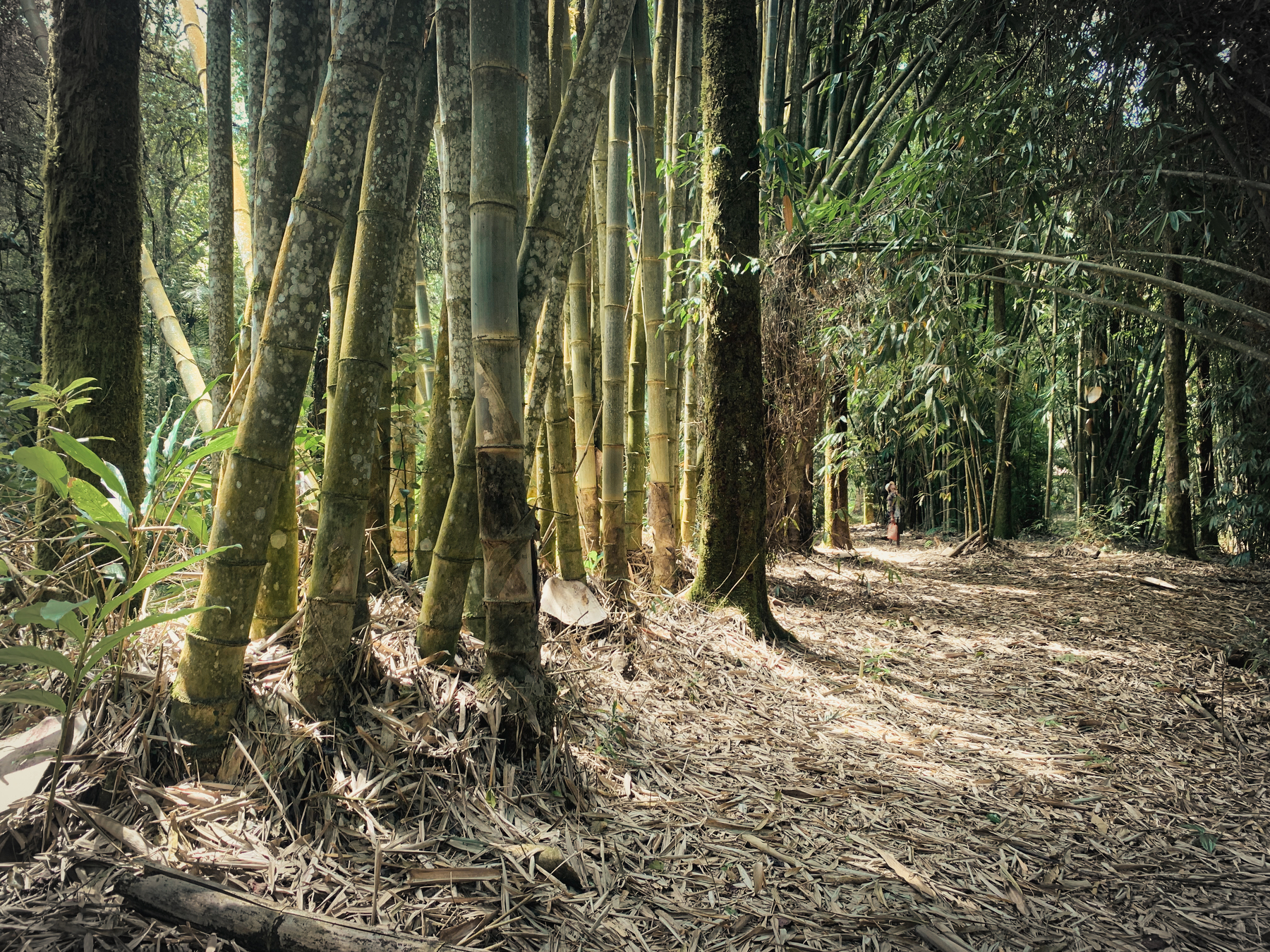
    photo of thick bamboo trunks, colors of olive and old lime, standing together, and fallen husks around like scattering parchment, and a dense carpet of beige bamboo leaves surrounded by other foliage.

    consistency //

    song for her

    my friend is brilliant, she lives inside a box
    her light is so strong, it made cracks into my house
    her cracks in everything, she’s uncontainable
    her container is a place of blinding peace

    she is so brilliant, that i’m afraid of her
    she is so quick, she catches me before i stumble
    she is so mighty, one piece of her becomes my whole
    by day her memory, by night her secret plan

    she is so brilliant, she broke into my dream
    i found her there, busy kitchening a shadow
    what she was making, i couldn’t wait to see
    was it a love potion, or did she want to poison me

    she is so brilliant, i tried to let her know
    i made a mirror, it was not the way to go
    i think i burned her, by what she wouldn’t say
    she is so brilliant, maybe i should have let her be

    she is so brilliant, but her mom sounds like a bitch
    i want to tell her, but i’m not sure about it
    she watches tv, and i think it makes her sad
    i’d let her see me, but her brilliance drives me mad

    she is so brilliant, but our interspecies owl
    if she’s leucistic, and i might be a wolf-man
    if i’m too mystic, my tooth and claw and howl
    to hold her close, i’m gonna fry them in a pan

    she is so brilliant, i take time to process her
    or i’m a house-cat, high-rolling in her sunshine
    i soak it in, through my fur into my bones
    chasing lit inches, and i don’t even mind

    lacking her brilliance, i wrote a song for her
    it’s cos i’m foolish, my words are pawns for her
    i just can’t help it, i need to let her know
    how brilliant she is, that i could never let her go

    she is so brilliant, that i could never let her go
    etc

    //

    not sarcastic

    //

    music by her

    //

    talisman

    a cup of chamomile, my open wound
    crepuscular, flowers steeping in the dream
    her springing forth, her taste exquisite autumn
    my speculative, formidable apple

    the steam is real, the stirring consequential
    the presence of the absence of a pear
    the buds are breaking up to touch the coiling
    epiphany already of her ear

    a brewing honey storm, holding and pressing
    the amber-letting cauldron of the year
    a chalice of molten golden, in case forgotten
    a promise to be warmly drunk, and often

    //

    the emerald vine

    sayangku, this is insane! is how i called
    to show him my translation. Wondrous bending
    noetic might, this miracle of earth—
    she called the way she calls him for a viper

    and it was chrysochlorous green, zithering neon
    in day-bright, venom visible, scroll shining
    un-minding, rubbing sleep out of her eyes
    quick-silvering to sprawling pumpkin vine to hiding—

    the same, the same, the same! but every word
    turned different, and all the rest went dim
    the sirens and the hooks, made dull and distant
    slow-honeyed hum, what frenzy, vital air

    the hungry lung was spitting, stitched and thinning-through
    to this—brilliance, broad-leafing light, breathing
    Egyptian smaragdine, Sri Rejeki, Mak Sun.
    but whoever wasn’t blind already knew

    //

    autopygmalesis / autopygmalysis
    Trimeresurus insularis
    previously, on

    //

    selamat purnama 🌕

    photo of bright and deep green leaves, broad star-shaped begonia leaves with maidenhair fern

    beauty breathers //

    monsoonal triptych

    //

    the lurch

    and rumble of distant, compounding thunder
    my favorite season is surrounding me
    horizon thickener, high-humbler shadow
    of mountain matter; wanting always more

    //

    the roar

    before the rain gets here—i hear it, do you?
    hot prophecy of gutters fish-flooding fields
    a landslide, eating bodies, spills raw earth
    white sound; what leaves are caught in it; coming

    //

    the opening

    of space, the possible wet-through as words
    after the waterwall; tree-creepers ring
    syncoptic service unreserved, pure nuncial
    desire; protean passant—rhythmic return

    //

    Polypedates leucomystax

    Socrates: (cont.) O Phaedrus, anyway—beg yourself to create (poie-o) right now, and quick, the very pleasures (ede / edos) that you will nonetheless create!

    // 228β

    σὺ οὖν, ὦ Φαῖδρε, αὐτοῦ δεήθητι ὅπερ τάχα πάντως ποιήσει νῦν ἤδη ποιεῖν

    //

    familiar

    if i remember you, i was fifteen
    your hair was knotted by dirty difference
    flecked-amber gibbous as my need for love
    your body pliable and bored for me

    (her mother hated your feral smell)

    three decades gone, my pace is set by ghosts
    and at the door, at least three cats or four
    familiar tempo territorial, you puzzled
    pigments with my pinkest calico

    (you should know we don’t do skim)

    we go, we pan the monsoon winds, we blow
    gold-dust up noses of tropic mountains
    resuscitate, topless in hard-top jeeps
    we are burning lucky indigo, lit dupa

    (what’s here that’s spendable is yours)

    who reads as suffering comes craving rhyme
    by planetary slow, the latest virgin
    almost born, in need of form, soft hand
    and shallow. Moon meadow, nettling in time

    //

    (she didn’t mean to make you cry)

    //

    🌖

    Socrates: (cont.) But in the end, he was always going to speak, and if someone wouldn’t listen willingly, then by force!

    // 228β

    τελευτῶν δὲ ἔμελλε καὶ εἰ μή τις ἑκὼν ἀκούοι βίᾳ ἐρεῖν

    //

    Naysayer (Kuntilanak nest in a bamboo forest)

    This nascent key would never be a song;
    Of roaring cells, erasing histories
    Of sound, before the cradle’s founding hush.
    Where ink blot habitats, mossy and lush,

    Mothered, she organized her room: a game
    Of pyramids, a smear of runs and zeroes.
    In attics to indifferent infinities,
    Neptune left mysteries troubled remains.

    A child bride was famished for the truth—
    I have no nasi. My broken bone sembako
    For pakis, spiral shoots of wooly fern,
    Blue-rumored eyes, intransigent bamboo.

    Go back again, return to your first time.
    This bed presents impossible as sin:
    Crossed limb, grown gravity’s unsupple twin,
    And sun impenetrant, absent the rhyme.

    Be quiet as the grove, posthumous ration.
    What lyre was greener than an arrow, slow
    As pain, and dense as destiny—known knot,
    No cut chords through your circumnavigation.

    //

    . . .

    //

    (santai; good leavening could make a year)

    Socrates: (cont.) And as the lover (erastes) of words was begging him to speak, he broke away, as if it was not his desire (epithume-o) to speak—

    // 228β

    δεομένου δὲ λέγειν τοῦ τῶν λόγων ἐραστοῦ, ἐθρύπτετο ὡς δὴ οὐκ ἐπιθυμῶν λέγειν

    //

    Socrates: (cont.) And meeting one mad for hearing words, and seeing him, seeing, it would pleasure him to possess a fellow Corybantic reveler, and he commanded him to lead—

    // 228β

    ἀπαντήσας δὲ τῷ νοσοῦντι περὶ λόγων ἀκοήν, ἰδὼν μέν ἰδών, ἥσθη ὅτι ἕξοι τὸν συγκορυβαντιῶντα, καὶ προάγειν ἐκέλευε

    //

    Lessons from the puputan

    cw: (historical) political violence and suicide.

    Another passage from Revolusi (David van Reybrouck), on the Balinese puputan of the early 1900s:

    “More horrifying still were the scenes in Bali, where in 1906 and 1908 the complete courts of a number of principalities chose to commit collective suicide (puputan). Hundreds of men, women and even children walked straight towards the Dutch rifles and artillery. They were dressed in traditional white garments and carried only staffs, spears and the finely wrought traditional daggers called krises. ‘The rat-a-tat-tat of gunfire went on, the fighting grew fiercer, people fell on top of each other and more and more blood flowed.’ A pregnant Balinese woman was one of the few who lived to tell the tale. ‘Persisting in passionate fury, men and women advanced, standing up for the truth without fear, to protect their country of birth, willing to lay down their lives.’ The KNIL [Dutch] soldiers couldn’t believe their eyes: women hurled their jewellery at them mockingly, courtiers stabbed themselves with their daggers and died, men were mown down by cannons. The wounded were put out of their misery by their relatives, who were killed in turn by the Dutch bullets. Then the colonial army plundered the corpses. In the puputan of 1906, an estimated 3,000 people died. ‘The battlefield was completely silent, aside from the rasp of dying breath and the cries for help heard from among the bodies.’

    “And this event, too, has left traces. In December 2017 I travelled around a near-deserted Bali. Mount Agung’s volcanic rumblings had put a stop to tourism for the time being, and in the ancient capital of Klungkung, I found the desolate ruin of the royal palace. It had been destroyed after the puputan of 1908. ‘My grandpa, Dewa Agung Oka Geg, was there that day,’ said Tjokorda Gde Agung Samara Wicaksana, the crown prince of Klungkung. We were sitting in the new palace, opposite the ruin, and drinking tea. It was Saturday and his servants had gone home; he had made the tea himself. ‘The puputan of Klungkung was the very last one. After that, Bali was entirely subject to Dutch authority. My grandfather was only thirteen years old and nephew to the king.’ Almost the entire royal family died; the king and the first prince in the line of succession were killed, the king’s six wives stabbed themselves to death with krises, and 200 courtiers followed their example or were murdered. ‘But my grandpa survived.'”

    It isn’t emphasized in front of tourists—the hedonistic hordes landing on Bali every day, who come for sprawling villas, endless traffic jams, cheap labor, and the monetization and destruction of the island’s natural and cultural resources. But the Balinese valiantly, fiercely resisted Dutch colonial control. They did so, notably, by puputan.

    I’m not sure it would make any difference, if tourists were universally informed about the puputan. The days even of pretense seem to be gone. Ubud has transformed into an urban shopping complex, bloated by money, overrun by beach bodies. We rarely go there anymore, the traffic and high prices make it inaccessible. Locals have converted family homes to expensive boutiques, restaurants, and villas. Foreign-catering establishments occupy an upper echelon of public space, not unlike colonial resorts in the Dutch East Indies. These fantasy realms are inaccessible and undesirable to most working-class Indonesians, whose labor builds them, whose work is to wait on and serve the foreigners. Ubud, like Canggu and Kuta before it, has been smothered by gentrification.

    But my fantasy is that everyone is always remembering the puputan. These acts of solidarity are still alive—I know it—deep in the meaning of this island. We, following the Balinese, make offerings to the ancestors, in a sangga at our house, to show that we remember. And the mountain holds the memory.

    The puputan are a testament to a people and a place.

    //

    Now, Love—An abrupt change of topic? no—Love is difficult. I’m not sure it’s possible to love, outside of a context such as this.

    In my life, I have found it difficult to feel contentment in love. As soon as I feel a moment of contentment, I watch it happen—I’m gripped with terror at the thought that my beloved will die and be lost to me forever. I’m inundated by images of death—mine, his, that unthinkable loss. Love is terrifying because loss is terrifying.

    My husband (E) has always stated, plainly, his conviction that he will be there waiting for me, in the next life, and that we will live, in the afterlife, together forever. This is the deal, the very basis of our marriage—our marriage is truer than death. And it lends courage to love.

    I say to myself—“You needed to find someone who believed in monsters, to find someone who could believe in you.” Well, E was that person. He believes. Drunk off his imaginative capacity, I stopped disbelieving too. So at our house, we believe in Wewe Gombel, Kuntilanak, Tuyul, and countless others. There are more monsters and ghouls and djin and demons and mer-folk than I ever expected. It’s amazing. I believe in all of them!

    And if I ever feel a moment of cleverness, superiority, or doubt, concerning the reality of a ghost or spirit, I remember—I myself am the most dubious of all. I am, very truly, the dubious one! It’s a miraculous kind of bargain. I suspend disbelief in Wewe Gombel, and I suspend disbelief in myself. I couldn’t do it without E, I’d never heard of Wewe Gombel before him.

    That’s the grim overtone to a deeper harmony. What I also needed, was not just someone who believed in monsters, but someone who believed in mercy. I had booksmarts coming out of my eyeballs, but I didn’t know anything about mercy, until I met my husband. Mercy, itself a kind of monstrous irrationality, had also been unbelievable to me.

    //

    Cut to the dialogue, Plato’s Phaedrus. A relevant passage comes later in the text than where I am now. And yet the text is simultaneous with itself (unlike the blog). Here, it pierces into the beating heart. To paraphrase, from memory—and I’ll stop vouching for accuracy here, because why should I?—Socrates says he has no time for a skeptical inquisition against mythical beings, as being true or false, fact or fiction. His Wewe Gombel is Boreas, the North Wind, storied to have abducted Oreithyia, a maiden princess. He has no time, because he doesn’t yet know, of himself, whether he is full of rage, like a Typhon, or capable of mercy, partaking in the divine.

    The imperative, more urgent than doubt, is of divine provenance—Know thyself—and credited to the oracle at Delphi.

    The dialogue, having arrived at its poetically designated place—in the shade of a platanos tree—hints at things: that Socrates is, in his living truth, a mythical being; that Socrates is a character in a poem, of dubious reality; that Socrates is a monster. If Socrates doesn’t know, then how would we? Did, or does, the poet know? And if I fail to know Socrates, shall I forget myself?

    Maybe so. And if I am so unsure of myself, then by what desire and on what grounds shall I interrogate the truth of anything else? Am I only a monster, for monsters, reading a monstrous poem, written by a monster, about monsters?

    Is it monsters at war, this very poem, or is it a creature of mercy?

    These become inevitable and appropriate questions in this dramatic context, as Socrates and Phaedrus have left Athens. They have exited the city walls, in a poem that was written, historically, not long after Athens was defeated by Sparta and overtaken by the thirty tyrants; not long after Athens put Socrates on trial and killed him. That death also was a kind of suicide. And history bleeds into the poem.

    Now, we find ourselves in a lovely fantasy—is it the poet’s? Socrates and Phaedrus, for the purpose of the poem, are leisurely wanderers, or an infatuated lover pursuing his flighty beloved (two competing interpretations of the same dramatic action), beyond an unstable and oppressive political reality.

    And look—the questions out here are different than the ones in there.

    If the city serves as a container for self-knowledge, in the form of Justice, Virtue, or even the Good, what happens when you leave that container? How does anybody leave behind their city, and its laws, without becoming utterly lost? And what when the city crumbles, and a person survives? What basis is there for self-knowledge, if a human being is, as in this paradisical afterlife of the poem, an on the way thing?

    This question of human nature reflects the personal identity of the poet—exiled, abroad, otherwise absent—from a failing democracy. When there is no city to support or to limit you; when the laws have lost their definitive hold, by unlikely accident, a miracle, an error in your favor; or when they have destroyed the very foundation of their claim to Justice—who or what might you become? What is left for you to be?

    And why would you carry this poem in your pocket?

    //

    My husband and I have a pair of matched krises, these sacred daggers. They were passed down to E through his grandfather. Each has a wood sheath carved around it. These are ceremonial krises, not big dangerous daggers. And still, they feel heavier in the hand from the steel inside. His is smooth and broad, with a face like an inquisitive fish. Mine—witch-made, I am told, specifically for a woman—is sheathed in sandalwood, shaped like a bodkin, with a slender, split hoof at the end of the handle. E gave it to me after we married. I had a general idea of their meaning, like an athame. But I had never made the connection with puputan.

    My kris fell into my lap, as these things do. Now it sits in my bedside table, mundanely inherited, more-or-less imposing its presence. Now, who is the instrument of whom?

    Histories are alive with mythical animals. Always on the way, through wildernesses, we glimpse clearer selves—ours, theirs; past, present. Lightning flashes as responsibility in the dark. We follow the shining; that is love. We are seized by the wind, over edges of cliffs, bearing witness—to what? As unable to save others, as we are ourselves, we become unknown, are dead and gone, living among immortals. Any of these, or all.

    So the pen takes lessons from the puputan. A kris is an instrument of truth as freedom, the life of exit, wholeness through cutting. The blade makes a container for the uncontained. Clad in white, tossing its jewels at tyrants, bleeding itself into self-possession—

    Poetry is the puputan of logos.

    //

    coy loon, calico

    coy loon, calico
    cat snatched cake from the canang
    cinder coils cunning

    //

    Assalamualaikum + selamat purnama 🌕

    our exercise as exorcism of time —

    the oddly-staggered rhyme leaves bruises

    on buds stringently-steeped, the undisclosed

    grays of grass groped in dark of morning that

    took hold as roots in midnight, not knowing color

    not knowing how seemly to be in sun —

    steps right into the rhythm of blinding fire

    this prism of shadows is highways home, revealed

    in daylight’s reconciliation with desire

    //

    Selamat Idulfitri, Eid mubarak, blessed Eid to those who observe. 

    Alhamdulillahirabbil’alameen. 🌙

    //

    The result of all this “intelligence” // (A rant)

    In these final days of the holy month of Ramadan, I am publishing this “rant” on “AI” and technology. It is a long rant, cobbled together, rambling, error-prone, and possibly shouty at times, but with the enthusiasm of madness, rather than anger, I believe. I imagine it as tribute to the darkening moon, as well as Ogoh-ogoh, which is today in Bali. Ogoh-ogoh is when the demons (called ogoh-ogoh) go howling and yowling in the streets, causing violence and uproar, to be brought out, burned up and chased away for the next year. I didn’t get any photos today as we moved around our neighborhoods, but (oops, these probably are NSFW) here is the fabulous vibe.

    //

    I am not anti-tech. I am not anti-AI. But writing something like this feels like writing against a deluge of history, imagining the words scattered and lost in a roaring flood. (Relatable?) Sometimes purgation itself is a good thing, the locals seem to believe. There are demons in the street, I can hear them this moment, their words and their hyper-active laughter, their growls and groans and spat curses, the frantic drumbeats of their chaotic mission, accompanied by frequent pyrotechnics. So.

    Tech serves only the one in posession of tech.

    (Who is that one?)

    For the one in possession of tech, it makes things possible on different scales then pre-tech. Colonial and then industrial-scale genocide are examples of this, as are vaccination and virality.

    Communication tech (from carved writing in stone, all the way up to algorithmic social media and/or “AI”) doesn’t just convey power over bodies, but over hearts + minds, in ways that are not well-understood. (And at tech-enabled massive scales.) It grants someone (the one in possession of the communication tech) the power to sway populations.

    I am not anti-tech; I blog. (Even written language, as I wrote, I consider to be tech.) I have an iphone and an induction cooktop, I use tech all the time. I am even a tech lover. (Again, I blog.) But the use of technology (especially tech that creates new needs, i.e. luxury tech) builds a kind of ethical scaffolding (ἕξις or hexis, an active condition, disposition, or habit) for a narcissistic comportment in the world. Implicit in the building of tools, even the simplest ones, is the thought that the material exists only to serve the user. Technology progressively (re)defines the world as “material”. It serves the appetites of those who can pay for it (or invest in it). Every tech is an example of this, but it’s especially poignant when the “material” is alive, as with “factory-farmed” animals. Whether a chicken is mere material, or something in itself, has become irrelevant in the (modern western, but increasingly global) day-to-day world, built by human technology.

    Of course, it’s already happening: techno-fascism is the not-long leap of turning humans into “material” too.

    I am also not anti-artificial intelligence. I just have a different idea of what artificial intelligence means, than the people who are setting (and selling) the terms of the conversation.

    To discuss “what is artificial intelligence” would first require a discussioin of intelligence. I’ve seen no evidence or argument that what is being sold as “AI” even resembles intelligence. What paradigmatic “intelligence” are the “AI"s being tested against? What are the “benchmarks”? We are left to gauge the purpose of it by observing what it does. (This idea, “The purpose of a system is what it does”, is straight out of Aristotle too.) As far as I can tell, the benchmark of a language model is, to convince users that it’s reliable. That it doesn’t (often because it has been specifically censored) spit out a disturbing or offensive response. That when a user feels like double-checking, it matches extant data, until a user is convinced not to double-check anymore. It doesn’t matter whether the response is “true” or not, there is no available parameter for that, because “the true” is not present in the extant data. “The true” is not present in the sum total of the internet, or ten thousand internets. “The true” is not a statistical regurgitation of ten million all-over-the-place opinions.

    For “AI”-generated content, the “benchmark” (as far as I, an observer, can discern) is to convince people to keep watching, to keep scrolling, to keep using. The more people it convinces, the more money it makes, the more successful it is. And bonus, the proprietary “AI” has become an indispensable source (a medium through which to interpret the world) for an entire population.

    This is not knowledge, it has nothing to do with knowledge. My prediction is (to predict this seems trivial) that the holistic result of all this “intelligence” will be insanity. And then, war. Well, more war, and worse. Anyway, it strikes me as a contradiction.

    Intelligence doesn’t cause or profit off of war. Intelligence doesn’t cause or promulgate insanity. Intelligence doesn’t harm the weak. Intelligence without empathy isn’t intelligence. Intelligence isn’t complacent in the face of suffering. Intelligence doesn’t perpetrate or propel people toward self-harm, genocide, or extinction. When there is a cultural consensus on intelligence, according to which intelligence does these things, that is a sign of immanent catastrophe. So even if I am all alone in doing so, I reject that definition.

    Here are some “benchmarks” for artificial intelligence I would (conditionally) accept.

    • Peace.
    • Justice.
    • Health (global ecological health, including human health, including individual health, embodied and psycheic).
    • Vaccination against fascism.

    Where is the “AI” that prioritizes these? Not just in its words, but its actions?

    1. That “AI” would be far more resource-intensive than it would be profitable. 
    2. It wouldn’t produce reliable or universally-agreeable results, because while these are the most important human pursuits, they pose difficult (perennial) problems. The fantasy of a facile, universalizable, standardized answer is propaganda for fascism. 
    3. Good results would lead to less reliance on the technology, less engagement, and therefore less profit. 
    4. Therefore it will not be attempted, let alone made.

    So artificial intelligence, according to me, is not present in this “discourse”. Except inasmuch as any number of artists and writers and poets have always provided artwork-based interpretations of intelligence, of what it looks like or what it is, going all the way back to the (pre-human?) invention of artifice. Religious texts offer interpretations of intelligence, and state constitutions and laws, and music, and mathematics. They are all artificial intelligences. The intelligence of a dancer. Ptolemy discerning the intelligence of stars. Intelligence understands and makes room for itself as plural – it is neither an absolute, nor a scattered infinite of particulars, but worlds within worlds. Like a jungle, or an animal, or a coral reef. Or even, something like Ocean.

    Technology does not and never has had a monopoly on intelligence, no matter the propaganda they’re injecting into our feeds. Tech’s monopoly is on control.

    Just so, peace remains ever beyond the reach of technology, because peace is not imposed as control. That is the violent fantasy of fascism.

    The easiest and therefore the only path to (techno-)fascism is through insanity. This appears to be the “benchmark” and the purpose of what is currently called “AI”, because this is by-in-large what “AI” (in a mutually-servicing arrangement with algorithmic social media) does. It turns people into users, turns users into the used, and turns the Earth into a ball of flaming garbage. A junkies’ den. This is our new politics, or lack thereof. Other “use-cases” – (e.g., if it can practice and propagate anti-fascism as hexis, as an active condition) – will be rare, if not merely accidental.

    Because technology is essentially narcissistic and only accidentally good.

    It requires education as a precursor, with subsequent active intention and effort, for a human person to be healthy and good. Education if successful puts us on a path toward (empathy, as David said) sensing the depth of the full breadth of the world, as well as our own depths, and sensitizing us to our limits and boundaries in these contexts, rather than imagining ourselves to be little kings. So education was needed to temper technology. American education, including its incentive structures, has done almost the reverse. Not just by emphasizing STEM and pumping money into innovation, but also using standardized testing to measure children’s worth. By design, even our education has been in service to tech.

    As I’ve mentioned before, my only political view is (public, obviously) education. Education is the living soul of (human, obviously?) politics. All else in any political constitution should be organized to protect and serve education. While the end (telos) of education is active inquiry into the discovery, expression, and interpretation of justice, as the end (telos) of politics, of what it means to be just.

    That is the secret teaching of “philosopher kings”, by the way – that education alone must rule.

    (Here I offer yet another on-the-fly-interp of Plato’s Republic. I say it to acknowledge the hubris of it, but also to express gratitude for the ancient technology that has somehow educated me, though any errors are my own. And I might change the word order tomorrow. Wink emoji.)

    (Here I note further, as my “rant” fizzles out, that I never intended to write on the Republic for my blog, not even in oblique terms. This blog is a constant meditation on the Phaedrus, I stubbornly maintain, where we find ourselves in a quasi-mystical meta-political realm. However, here as in the Phaedrus, politics is fully capable of accompanying us outside city walls, presented and represented by its – ugliest and most beautiful – faces.

    For me at least, a reference to the Republic is a reference to the past. Lol, that’s also hubris. I hope very soon to get back to more direct engagement with the textual object of my adoration, beginning with some remarks on “the chariot”. However, I’m very bad at promises. The best way for me NOT to do something has always been for me to promise to do it. I would be a very bad employee of myself. Deadlines are unnecessary, we are worlds-building, after all. So no promises, just surprises.)

    This flashed across my incredulous and hungry eyes today. Okay. Islamaphobia, they say. But in another way (from another perspective of Islam) this is the truest tattoo you could ever get. It’s like getting a giant tattoo of “asshole” across your chest.

    We were laughing about it, because things suddenly seemed very funny. “Oke Jeki, go hunt it like a cicak (gecko),” my husband said. And we just couldn’t stop laughing, it was just so funny. These are the useful idiots of the basilisk.

    All it has are its useful idiots.

    Mask firmly engaged: these long posts always strike me as narcissistic. For example, imagining all the time it would take someone to read these words, and still posting them. So I guess one thing I’m wandering-around-about-on-here is the possibility of whether you can fight narcissism with a narcissistic act. This is what poetry is, and anyone who has ever experienced a glimmer of the joy of writing knows this, even if they won’t admit it, that poetry is engagement of a deep (and hopefully redeemable, if somehow self-defeating) narcissism.

    I control every little blip that’s on here, almost.

    //

    Tomorrow is Nyepi, Bali’s silent day, so the demons fly away. For twenty-four hours we’re not supposed to make noise or use electricity, and internet and celular are often down. Even though I guess nowhere else celebrates Nyepi, I can still say Selamat Nyepi, have a nice Nyepi. Even from a distance, to imagine an island (a party island) that is totally peaceful, no cars or motorbikes or airplanes, with birdsong taking over the entire sky, as if everybody has suddenly disappeared, an empty day that darkens down quickly to unlit night, so that it disappears from the satellite photos, is also an effect. So just imagine the sound of Bali without humans. That’s where we will be, when the purification rites are over, and I’m not posting on my blog.

    Thanks for reading, if you got this far. Assalamu’alaikum warahmatullahi wabarakatu. 🔥🌑✨

    //

    Ramadan vibes. // Cozy, calibrating, sedating. Feelings of sahoor. Being awake and only half-alert during the darkest, the quietest, the coldest hours of the day. Wearing ankle-socks, drinking a small cup of coffee in bed. Gaining clarity, then working (reading, writing, occasional chores) as the sun comes, light born as from quietude, and the day grows, the beams angling upward into bright hot activity. The hour is earlier than it seems.

    The best time I’ve tested for yoga practice is around noon, mid-day. It’s hot and my practice is three hours of sweating. I drink enough water to rehydrate.

    Later, the hypnotic hunger-doze of afternoon. Indecisive napping. A flurry of preparation before sunset, and about thirty minutes of hangry vibes, (grouchy and efficient are incompatible modes), before it’s time to eat.

    Maybe takjil (Indonesian snacks especially for breaking the fast at iftar) are sweet and cool to soothe the nerves of the final hour. Today we shared a big protein shake, frozen banana - vanilla protein powder - coconut water - chia seed. Thick and superfoody. This is bougie takjil. High in electrolytes, to help with hydration, and protein, which I am really craving by then. Chia seeds are one of the few “superfoods” I kind of believe in. They feel nourishing, filling but not bloating, easy on the digestive tract, excellent for stamina. The jelly-seed texture is inherently comforting.

    Some days (especially non-yoga days) we’ll drive to the nearby Muslim kampung and hunt down real (sugary) takjil. The pre-iftar neighborhood “cruising”, everyone aimless and out-of-it toward the end of the fast, (the soporific Ramadan vibes), is another casual but recurring ritual of the holy month. There is a sense that the Muslim community draws closer, contracts, and even I am a part of it.

    Assalamu’alaikum warahmatullahi wabarakatu. 🌘

← Newer Posts Older Posts →