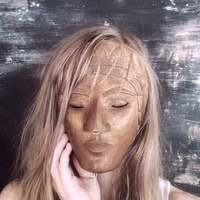
Family
Phaedrus: (as Lysias, cont.)
and when (as seems inevitable)
disagreement comes to be
and the mishap
in any other way
would be set down as common
to both
// 232β
καὶ ἄλλῳ μὲν τρόπῳ διαφορᾶς γενομένης κοινὴν ἂν ἀμφοτέροις καταστῆναι τὴν συμφοράν
//
selamat calendar complex
Ogoh-Ogoh for tilem today
and family calls and the gamelan calls
(seen here, here, here, here?, nsfw?)
when having constructed our demons
we carry them through the streets
and shake them and fight them
and turn them and burn them
and ooh and aah and waow
and laugh and breathe fire
and then
collapse
into
Nyepi tomorrow
no outgoing or talking
or fire or electricity
or internet
or working
or lovemaking
we let the ogoh-ogoh
believing it to be uninhabited
pass harmlessly over the island
so tomorrow will be silent
in the valley as well
no posts from me ok
then (we await
confirmation from the village
its all local time) Eid al-Fitr . . .
//
lipsblum and parfum ooze
the cherries fell and placed their fingerprints
between my feet like small mouths of a month
of its here its a bloody wee well of a red whale
her fluke-petals strewn long the grey and white tile
and smudge of a moth in the blossoms to clear
but im always her hem and im on the sore brink
of love with the let-jet and inky-bruise style of it
like my pussy would write her own un-willing book
would underwear-stain me an avant-garde blotch
of enfant terrible for primordial brood
elsewhere wind-egg dramatic and lithe acrobatic
some brown-wise residuum to raging en rouge
sex-flowing battle and kiss-knowing cramp
my blew-brewing worm of verbage vole-damp
a crescendo howled in my bowling-ball clamp
and how you offered to switch off the lamp
so i wouldnt need to move at all
so i lie lust-fallow-unfastened at last for now
and i shower near the violet melati that you grow
with slugs softly tucked in a wet toilet paper roll
//
🌖
//
after
the easy way out
saucy
like a bruise
cherry
&c
& the maskmaker
who called lip balm that
♥️
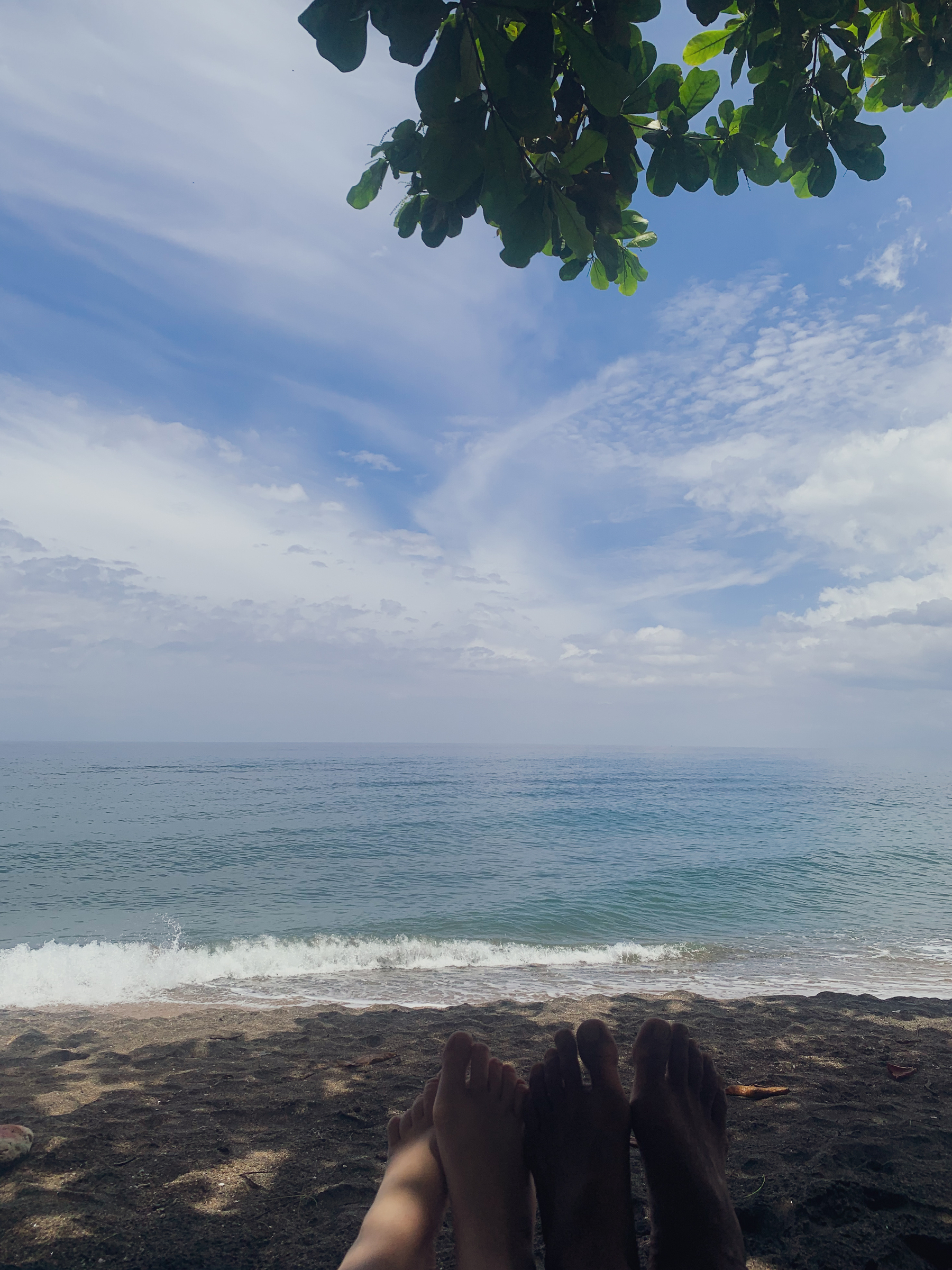
santai di pantai
big ocean rolling here, nearby
where me and my too luminous
for my own good maskmaker
are santai, on our anniversary
purnama pulls the swelling tide
like poetry, erasing traces
the waves of endlessness reply
by silver water, silver sky; and we
like sand and salt, by speech unsifted
//
🌕
thremmata
corpse pose again, is it for real this time, as i
down to the underworld for Hades lower table
descend, the darker cloud of somebodys forever
to a banquet feast of charred fat strewn with ashes
i sit before the offering of my own left shin
my tender bone is bowing its familiar flaw
my meat is dripping ratios from the burning violin
i eat it all, although my name is not Issa
as eat the dead, by whispers, one million and seven
then i look down to find beast-legs with chestnut hair
my knuckled shanks uncrossed, my hooves are lightning-cloven
my kept creature walks on two or four, tall-horned
whose crescent shavings will be ground into the rock
whose name is leaving many by the blade of one
//
and the rod
Black Ajax bitter on my left
Red Ajax blooded on my right
grim speechless my bronze-armored kin
by serpent held Asclepian
//
a-courting, or the word used here
we mampir with Blih at the house of his girlfriend
to meet her mother, by his side, the maskmaker and i
as family representatives or peopled containers
my labels are to smile and nod with genuine interest
to follow the conversation, for extra credit
to support Blih, we drive him there and back
to eat and drink what we are given, to stay as long as it goes
to coach him in the car, to ease his nerves broaching
the sensitive topics, to approve, one step of many
both already divorced, he’s two years older than us
she is a few years younger, expressive, at ease
a tempering of his toughened wants and weathers
just to us he mentions, maybe a baby; pretends
not to be enchanted by a computer-generated mockup
//
🌓
as making do
was worked exquisitely until worked out
a nagging, no-good splinter, studied bit
from the toe-ball mound of some leviathan
mere sliver; then salvaged by a maskmaker
if mountain makers last by root and bud
of artful past from a forgetful dancer
sequestered in their unearned sorrow, sung
too low and dear for an angry wound to hear
too clear for tears or dollar bills to hold
but a mask is living loss returned to wood
impossibility the daily ending felt
itself not made nor lost enough to face
so held and turned; for an ugly splinter
with yet some reservoir of mammoths blood
in love, it was an advantageous marriage
//
Pharmakeia’s triptych
trippy destiny
true story: in her salad bruising days
her myspace name was like a prayer, Pharmakeia
the profiled face was drawing of a death
cap mushroom; well, consistency
and every day a salad day
and every day un po’ di morte
today, when sniper scopes an urban label
the same shaded and subtle botanical
renderings pop up from top of neon heap
left truffles for her canny little pig
for snorts and tickles, yet
a fact; and do you trust it
//
what marriage
the maskmaker who daily carries her
drew sigil gold and black on brown bag paper
Al-Lateef—his soft likeness sleeping by her pillow
beloved names for her beloved way
what reck does come to find
what wreck that came to ground
as travelers witness landslides and inundations
upheavals that by eagle’s eye the aftermath
counts losses, failure, countlessness; what hand
to brush a tawny cow, her long-lashed eyes
what blinded word to see
what marriage of then and now
//
big girl
she sees, by name, the blue of heaven’s white
behind how obvious a giantess
the light, the light, it hurts to look at it
so brightly shines a lofty signature
built body born from Isis warm
and catching form her dulcet veil
some Aphrodites are, it’s said, too tall
to be from brick wall read, too high to see
by tools of masonry; how broad her arms
great fools embracing sky of marbled earth
her reckoning like reckless love
big girl logician
//
🍄
notes from Kuningan
morning hari raya / upacara / island turning // take the blessing / by notation / if i may // Pak and Bu S— / morning offering / shrine at home // rains a little / as we are greeting / laugh it away // i place the canangs / with lit dupa / ini di bawa, ini di atas nggih // with shredded pandan / shoo the cats away / the kue is not yours // then time for dressing / always late again / ceremonial demand // kebaya sunny yellow / olive peacock batik, gift from Ibuk / mauve selandang // polyester lace is tight / not my usual / glossy korean lipstain (bare fig) // to Penestanan / in the car now / windows down barricade // traffic pecalang / all day this way / Bali holiday // people fill the street / everyone is smiling / they recognize our face // he knows everyone / stops for everyone / a face for everyone // salam for everyone / friend for everyone / how many promises to mampir // banjar clear / on the way again / ceremony in the air // double-park the car / the cock-fight corner / across from pura dalem // at our old place / pandemi family / second home again // pass your body / around the family / salim for elders / salim from little ones // receive the bodies / moms and sisters hold you / feel you and pat your curves // meet Blih’s girlfriend / she seems good for him / marriage when // Ibuk Penestanan / enduring smiling / to see my face // she brings us coffee / kripik and kue / water from warung // and i’m too rare here / somewhat guilty / the intensity // the affection, her skin is so fair / but not too fair, she’s looking healthy / they note some extra weight // under comment / they discuss me / i endure // Bapak L— / talking death again / Mase scolding him // six large koi / in a clean but crowded pond / tadpoles nibbling at their scales // Mbok A— is here / older sister / the secrets she endures // heroic / (…) / by another woman // the delicate child / slender hand held / so as not to disappear // he takes my phone / for an interval / makes us watch a video // sea monsters suddenly / el gran maja versus the bloop / this detour for a while // softest fingers / feathering the touch screen / when he was small he didn’t talk // he couldn’t look at us / he wouldn’t speak to us / he ran away // now he’s outbound / needs to show us / sea monsters a serious event // an old mango tree / outside the home gate / branching over the street // when they ripen / he climbs to take them / no apparent fear // all day people passing / in the street below / teenagers outside the minimart // boys in udengs / girls in kebaya / all wearing sarungs // and then it’s coming / time to prepare / baskets and the flame // at the front steps / there’s a mat there / we kneel on it // kebaya itchy / sarung binding / squeeze onto my knees // off my sun hat / off my sunglasses / pale under the sky // the rain is clearing / by the rainworker / smoking his cigar // the women place the offering / burn the dupa / receive the blessing // remake the street / here come the god seat / make space for it // sound approaching / mangku rushing / the time is near // a flood of boys, boys, boys / marching sleeves rolled / red hibiscus in white udeng // here the mangku splashing water / wet blossom blessing / hands receive it // head receive it / face receive it / heart receive it, if it can // the passing concentration / bending flute line / twirling attention // pray the empty / pray the flowers / learn to pray // then we double it / give it happening / take a moment to form // now it’s coming / moving down the street / presence on the way // percussion heat / heart flame beat / bronze opening // bathe the flowers / in the smoking / fold them behind my ear // great gong agung / deep expanding / down belly through feet // make space for sesuwunan / come the barong / guardian of the street // women carry offering / towers balance on their heads / jeweled baskets overflow with cakes and fruit // see the dewa / vision loves them / eyes following // golden armor / grassy black mane / bulging eyes // then start shimmying / snapping teeth / shuffling the feet // flip-flops in the front / flip-flops in the back / shaggy with a bouncy tail // barong is dancing / attendants touching calves / steady exhausting underneath // forest guardian / body bearing sun-wheel / banjar medicine // then we follow / walk the family / take it through the street // walk with sesuwunan / holding hands again / don’t let him disappear // pray for island / pray for family / pray for banjar // boys are laughing / keep the music / challenging the air // in the made space / music opens it / opening is here // pray for earth / pray for spirit / pray down hard // see it feelingly / cracking open / then deplete // campaka blossoms / in barong beard / my favorite part of him // makes him handsome / red hibiscus / jepun ylang ylang
the fragrance / how it follows me / into the next day
//
the maskmaker’s wife (a prequel)
true, i killed a spider on thursday
it was counter-intentional, a blow
i cried for hours about it, hormonal
oceanic, and only later realized how
i was folding the hung-up laundry
i saw and tried to shake the hider out
from black denim, furry humble pro-leaper
but i miscalculated; too much snap
a streak of ichor mud across the web
between my right thumb and pointer finger
she unwound inches before she emptied
and died; i was so sad; i am so sorry
sorry, sorry, i spoke to her crumpled self
recriminations. what left—a legacy of masks
some translator inside a house of masks
and O how many masks there were for mercy
//
the time i was murdered by my own poetry, vol. x
slugs in the shower, laron tonight
fertile swarm; birth/life/death 2.5 hrs
box of tissues; hollywood tomorrow
//
the dancer
when kindness is as kindness shows
the son his mother’s body knows
my eyes are from another place
i smile at you to show my face
the lessons of an artist’s life
are gifts you rendered to his wife
he’s gentle as the fallen rain
what tokens we give back again
a sudden street, a stranger island
with traffic from a broken time
he’s holding her, she’s not alone
the dancer is already home
let’s draw again the graceful scene
in blouses pink, you met Christine
if recognition makes you laugh
he shows you with a photograph
a feeling hewing to the bone
her shapes are not unlike my own
she’s holding me, she’s not alone
the dancer is already home
what light there was is in your eyes
her singing voice was village wise
he looks for her before sun sets
and child again her own forgets
and he will press your softened hands
the gestured words, the closing fans
and holding you, you’re not alone
the dancer is already home
//
for Ibuk
//
selamat hari raya Galungan🌾
//
triptych of the dog
//
a cicak dropped a souvenir on me
yesterday, savasana; it was
all happening, pure rejeki, a speck
for playing dead; the simmering night, the sawah
was fizzing and burping boggy chemistry
the gamelan deliberated depth
of banjar space, a soup of bronze and spittle
//
up i, cocks crowing death to rest, dark mind
the cat was sick again, shit cleaned, cats fed
the breath of rain, half-there, in vomit stepped
scrubbed vinegar again, who made the bed
i squinted past the dawn to wash a dish
the load of towels, it was not a test
the shape of chasing weather for a bone
//
and would the three of them have made a city—
Lysias, Lysias, Lysias; he wasn’t there
he wasn’t here, until bumbu for our sambal
did rain down from the sky, and i said Lord
i still deny that you’re an onion seller
how practice held like density, as though
svanasana could house the dog itself
//
🌒
//
see also Rabia Basri
the horse’s mouth
teloscopically, my dear, are we botany
born reading leaves, the pricking fear of bees
are talking, my lisp, or rearing wobbly nature
what place, organs and bodies, this disease
the shying seasons blowing through us, here
parts animal in starts, quivering vibrations
made artifacts suspect by cities, near
or far, the accidents survived, the prisons
that ended us; the motes and moths in teas
our flicks or running rivers; wicked courses
of understanding; what catastrophes
what phase our faces, without the faith of horses
you have to have a horse whose feet you trust
to warn you when a snake is in the grass
the serpentine who wants to be unseen
repenting for her gemstone like an asp
for forking tongues, a talisman is key
but wear a hat, they’re speaking from the trees
odd shrubberies are bristling with false friends
a firecat bristling back can help with jinn
mosquitoes here are vectors for torpedoes, so
herbal experiment and/or gorilla war
sometimes there’s one snake, sometimes there are more
at least, no kind of viral is a pearl
a tender canter, daemonic carousel
remembered ribbons bite in ancient ways
we play the venom clockwise in our veins
we shed the dead redundancy of days
my jungle is a dreadful-clever dreaming
with shade-grown coffee, waterfalling views
what godly voices animate my evening
there’s none i’d rather jungle with than yous
let’s nicker maps, reverb the mythic blues
i spell, where y’all are going, where you been
switch witches laughter with the beating rain
the crickets will out-round the macet, friend
to live outside the law, you must be honest
Bismillahirrohmanirrohim
by river dark, inside a wounded dawn
we rhyme it, we just flow to make it rheme
//
(Dylan, my Prophetﷺ, Cohen, Cardi B, etc)
//
diet
never too much
garlic, carrot, oat
sleep, cake
but gingerly
the fungi
//
semi-nude for a photo album
their birthday was the other night
the girls were going out; the grift
delayed by getting ready; gift
of tangled, sappy rattan; caused a fright
pan, she burned some flowers on you
meta-burban, real dream for two
polaroid tacky, pantries full
of shady tatters, curtain bulls
sister, it was no dress for winter
but they were grown enough to drink
something fancy from the blender
fermented guava, lava lake
lavender flannel, camisole
white linen sheets, hung in the sun
nigel and sandi, mel and sue
genre-bender, Java won
high horse, he has a song for you
but i’ll save it for another tone
her sweaty practice, overdue
vinyasa, tapas, organ brew
dizzy lizzy ate some rice
eat, pray, love, the antichrist
jihadi, mum’s worst nightmare
Gandhi, papa’s burnt-off limb
inter-dimensional makeout queen
Osaka airport, caused a scene
village gossip, words above
she’s never catching up on love
not quite posh, but pulp turned through
realism, my lands, god knew
so sliced the flippin' longitude
bless her heart and come on in
agrimony henbane dish
too-schooled harpy hysterical
raised pie of huckleberry fish
turned river-liver radical
there’s mantra in the air tonight
what kue set in sangga stone
rise with the moon, the howling dog
the crone, her voice memorial
white-footed goat is coming home
to graze by fiery sunset view
the desert camel, bringing bones
with mother Durga, chest tattoo
a secret pocket of soil and spice
elaborate belty-thing, rhizomes in knots
not big enough for where you think
whether it is cake
//
(wants cake)
//
texas talkin blues, like this
vernacular from full moon 5/11
genius loci, pura dalem
blog 2-yr anniverse & job well done
//
the emerald vine
sayangku, this is insane! is how i called
to show him my translation. Wondrous bending
noetic might, this miracle of earth —
she called the way she calls him for a viper.
and it was chrysochlorous green, zithering neon
in day-bright, venom visible, scroll shining
un-minding, rubbing sleep out of her eyes;
quick-silvering to sprawling pumpkin vine to hiding —
the same, the same, the same! but every word
turned different, and all the rest went dim;
the sirens and the hooks, made dull and distant;
slow-honeyed hum, what frenzy, vital air.
the hungry lung was spitting, stitched and thinning-through
to this — brilliance, broad-leafing light, breathing
Egyptian smaragdine, Sri Rejeki, Mak Sun;
but whoever wasn’t blind already knew.
//
autopygmalesis / autopygmalysis
Trimeresurus insularis
previously
//
🌕
familiar
if i remember you, i was fifteen
your hair was knotted by dirty difference
flecked-amber gibbous as my need for love
your body pliable and bored for me
(her mother hated your feral smell)
three decades gone, my pace is set by ghosts
and at the door, at least three cats or four
familiar tempo territorial, you puzzled
pigments with my pinkest calico
(you should know we don’t do skim)
we go, we pan the monsoon winds, we blow
gold-dust up noses of tropic mountains
resuscitate, topless in hard-top jeeps
we are burning lucky indigo, lit dupa
(what’s here that’s spendable is yours)
who reads as suffering comes craving rhyme
by planetary slow, the latest virgin
almost born, in need of form, soft hand
and shallow. Moon meadow, nettling in time
//
(she didn’t mean to make you cry)
//
🌖
Needleworker
Pierce me once—the crying; pierce me twice—
The dying; pierce me thrice—my laughing tomb:
This quivering feline skin, some kind of lark,
Sharp noise, felt aerial, fled human wound.
O Queequeg, Lucy’s love, my Nobody!
Unmake ambergris soufflé to scrap and salt;
Pets, lapping shattered tiramisu, whet
Our mongrel tongues; embroidering the asp.
Bull-revelry, before we dance the waltz?
Your sutra swans around my ichthyan lisp,
To charm the vipers out—that feather in
Your bonnet inks my tapestry with bone.
I move to tiger with you on the cusp
Of animality, that golden-threaded throne.
//
🌘
Echo
Echo is opposite the word. He is
Mornings and evenly draws rainstorms down
From higher altitudes. Palm nectar slips the weather
From misty lakes, my ashes, unspooling ghosts.
But can you memorize the blues? Cintaku —
A promise to be golden rings untrue.
My skin is apple nude, my flesh a snowy hue.
This guava is Antarctica for your bottomless thirst.
//
Lessons from the puputan
cw: (historical) political violence and suicide.
Another passage from Revolusi (David van Reybrouck), on the Balinese puputan of the early 1900s:
“More horrifying still were the scenes in Bali, where in 1906 and 1908 the complete courts of a number of principalities chose to commit collective suicide (puputan). Hundreds of men, women and even children walked straight towards the Dutch rifles and artillery. They were dressed in traditional white garments and carried only staffs, spears and the finely wrought traditional daggers called krises. ‘The rat-a-tat-tat of gunfire went on, the fighting grew fiercer, people fell on top of each other and more and more blood flowed.’ A pregnant Balinese woman was one of the few who lived to tell the tale. ‘Persisting in passionate fury, men and women advanced, standing up for the truth without fear, to protect their country of birth, willing to lay down their lives.’ The KNIL [Dutch] soldiers couldn’t believe their eyes: women hurled their jewellery at them mockingly, courtiers stabbed themselves with their daggers and died, men were mown down by cannons. The wounded were put out of their misery by their relatives, who were killed in turn by the Dutch bullets. Then the colonial army plundered the corpses. In the puputan of 1906, an estimated 3,000 people died. ‘The battlefield was completely silent, aside from the rasp of dying breath and the cries for help heard from among the bodies.’
“And this event, too, has left traces. In December 2017 I travelled around a near-deserted Bali. Mount Agung’s volcanic rumblings had put a stop to tourism for the time being, and in the ancient capital of Klungkung, I found the desolate ruin of the royal palace. It had been destroyed after the puputan of 1908. ‘My grandpa, Dewa Agung Oka Geg, was there that day,’ said Tjokorda Gde Agung Samara Wicaksana, the crown prince of Klungkung. We were sitting in the new palace, opposite the ruin, and drinking tea. It was Saturday and his servants had gone home; he had made the tea himself. ‘The puputan of Klungkung was the very last one. After that, Bali was entirely subject to Dutch authority. My grandfather was only thirteen years old and nephew to the king.’ Almost the entire royal family died; the king and the first prince in the line of succession were killed, the king’s six wives stabbed themselves to death with krises, and 200 courtiers followed their example or were murdered. ‘But my grandpa survived.'”
It isn’t emphasized in front of tourists—the hedonistic hordes landing on Bali every day, who come for sprawling villas, endless traffic jams, cheap labor, and the monetization and destruction of the island’s natural and cultural resources. But the Balinese valiantly, fiercely resisted Dutch colonial control. They did so, notably, by puputan.
I’m not sure it would make any difference, if tourists were universally informed about the puputan. The days even of pretense seem to be gone. Ubud has transformed into an urban shopping complex, bloated by money, overrun by beach bodies. We rarely go there anymore, the traffic and high prices make it inaccessible. Locals have converted family homes to expensive boutiques, restaurants, and villas. Foreign-catering establishments occupy an upper echelon of public space, not unlike colonial resorts in the Dutch East Indies. These fantasy realms are inaccessible and undesirable to most working-class Indonesians, whose labor builds them, whose work is to wait on and serve the foreigners. Ubud, like Canggu and Kuta before it, has been smothered by gentrification.
But my fantasy is that everyone is always remembering the puputan. These acts of solidarity are still alive—I know it—deep in the meaning of this island. We, following the Balinese, make offerings to the ancestors, in a sangga at our house, to show that we remember. And the mountain holds the memory.
The puputan are a testament to a people and a place.
//
Now, Love—An abrupt change of topic? no—Love is difficult. I’m not sure it’s possible to love, outside of a context such as this.
In my life, I have found it difficult to feel contentment in love. As soon as I feel a moment of contentment, I watch it happen—I’m gripped with terror at the thought that my beloved will die and be lost to me forever. I’m inundated by images of death—mine, his, that unthinkable loss. Love is terrifying because loss is terrifying.
My husband (E) has always stated, plainly, his conviction that he will be there waiting for me, in the next life, and that we will live, in the afterlife, together forever. This is the deal, the very basis of our marriage—our marriage is truer than death. And it lends courage to love.
I say to myself—“You needed to find someone who believed in monsters, to find someone who could believe in you.” Well, E was that person. He believes. Drunk off his imaginative capacity, I stopped disbelieving too. So at our house, we believe in Wewe Gombel, Kuntilanak, Tuyul, and countless others. There are more monsters and ghouls and djin and demons and mer-folk than I ever expected. It’s amazing. I believe in all of them!
And if I ever feel a moment of cleverness, superiority, or doubt, concerning the reality of a ghost or spirit, I remember—I myself am the most dubious of all. I am, very truly, the dubious one! It’s a miraculous kind of bargain. I suspend disbelief in Wewe Gombel, and I suspend disbelief in myself. I couldn’t do it without E, I’d never heard of Wewe Gombel before him.
That’s the grim overtone to a deeper harmony. What I also needed, was not just someone who believed in monsters, but someone who believed in mercy. I had booksmarts coming out of my eyeballs, but I didn’t know anything about mercy, until I met my husband. Mercy, itself a kind of monstrous irrationality, had also been unbelievable to me.
//
Cut to the dialogue, Plato’s Phaedrus. A relevant passage comes later in the text than where I am now. And yet the text is simultaneous with itself (unlike the blog). Here, it pierces into the beating heart. To paraphrase, from memory—and I’ll stop vouching for accuracy here, because why should I?—Socrates says he has no time for a skeptical inquisition against mythical beings, as being true or false, fact or fiction. His Wewe Gombel is Boreas, the North Wind, storied to have abducted Oreithyia, a maiden princess. He has no time, because he doesn’t yet know, of himself, whether he is full of rage, like a Typhon, or capable of mercy, partaking in the divine.
The imperative, more urgent than doubt, is of divine provenance—Know thyself—and credited to the oracle at Delphi.
The dialogue, having arrived at its poetically designated place—in the shade of a platanos tree—hints at things: that Socrates is, in his living truth, a mythical being; that Socrates is a character in a poem, of dubious reality; that Socrates is a monster. If Socrates doesn’t know, then how would we? Did, or does, the poet know? And if I fail to know Socrates, shall I forget myself?
Maybe so. And if I am so unsure of myself, then by what desire and on what grounds shall I interrogate the truth of anything else? Am I only a monster, for monsters, reading a monstrous poem, written by a monster, about monsters?
Is it monsters at war, this very poem, or is it a creature of mercy?
These become inevitable and appropriate questions in this dramatic context, as Socrates and Phaedrus have left Athens. They have exited the city walls, in a poem that was written, historically, not long after Athens was defeated by Sparta and overtaken by the thirty tyrants; not long after Athens put Socrates on trial and killed him. That death also was a kind of suicide. And history bleeds into the poem.
Now, we find ourselves in a lovely fantasy—is it the poet’s? Socrates and Phaedrus, for the purpose of the poem, are leisurely wanderers, or an infatuated lover pursuing his flighty beloved (two competing interpretations of the same dramatic action), beyond an unstable and oppressive political reality.
And look—the questions out here are different than the ones in there.
If the city serves as a container for self-knowledge, in the form of Justice, Virtue, or even the Good, what happens when you leave that container? How does anybody leave behind their city, and its laws, without becoming utterly lost? And what when the city crumbles, and a person survives? What basis is there for self-knowledge, if a human being is, as in this paradisical afterlife of the poem, an on the way thing?
This question of human nature reflects the personal identity of the poet—exiled, abroad, otherwise absent—from a failing democracy. When there is no city to support or to limit you; when the laws have lost their definitive hold, by unlikely accident, a miracle, an error in your favor; or when they have destroyed the very foundation of their claim to Justice—who or what might you become? What is left for you to be?
And why would you carry this poem in your pocket?
//
My husband and I have a pair of matched krises, these sacred daggers. They were passed down to E through his grandfather. Each has a wood sheath carved around it. These are ceremonial krises, not big dangerous daggers. And still, they feel heavier in the hand from the steel inside. His is smooth and broad, with a face like an inquisitive fish. Mine—witch-made, I am told, specifically for a woman—is sheathed in sandalwood, shaped like a bodkin, with a slender, split hoof at the end of the handle. E gave it to me after we married. I had a general idea of their meaning, like an athame. But I had never made the connection with puputan.
My kris fell into my lap, as these things do. Now it sits in my bedside table, mundanely inherited, more-or-less imposing its presence. Now, who is the instrument of whom?
Histories are alive with mythical animals. Always on the way, through wildernesses, we glimpse clearer selves—ours, theirs; past, present. Lightning flashes as responsibility in the dark. We follow the shining; that is love. We are seized by the wind, over edges of cliffs, bearing witness—to what? As unable to save others, as we are ourselves, we become unknown, are dead and gone, living among immortals. Any of these, or all.
So the pen takes lessons from the puputan. A kris is an instrument of truth as freedom, the life of exit, wholeness through cutting. The blade makes a container for the uncontained. Clad in white, tossing its jewels at tyrants, bleeding itself into self-possession—
Poetry is the puputan of logos.
//
Servant
Tugging, the tusked equine,
Weightier than I am,
Was stamping and dragging
Its hooves, stubborn as dirt.
Fire married this mare, with
My tiger’s fang, dripping,
Driven as divine work—
To crack the crocodile.
If Earth would just hold still,
I could stanza your bridle.
Be mine—our lashes will
Whip rows into the jungle.
Eyes rolling, muzzle defied
Flea-bitten game—To bind
Me, noble by a thread,
Burning by landslide letter.
Your father spotted stripes
Rendered to mountain blades.
He didn’t dare to breathe—a whispered
Kris, my stalking shade.
Desire, the conquered theme,
Laid bare the ravined island—
Servant by my reins,
Red rivers spilling by mane and tail.
//
🌘