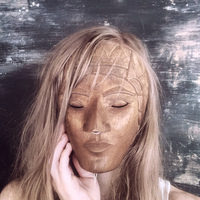
…this, to the extent that when colonizers came to the island and saw someone speaking with a mountain, they called it animism. By which they meant, since you don’t pray to Mickey Mouse, you must believe that the mountain is beefcake grandpa. A mountain person told me how offensive and idiotic this was, (they brought it up, told me their side of the story), I said you only know the half of it, and told them the meaning of anima. (Soul, air, breath.) The mountain person said, “I guess we do kind of believe in that,” and I said, “They don’t know the meaning of their own words.” The mountain person said, “Our god cannot be described in words.” (Anthropologists call it, “primitive.") (To speak with a mouse, or to disbelieve in a cartoon?) In retrospect it’s no surprise, colonizers go around with so little understanding of where they themselves come from, that even the mountain person, after uncounted crimes that are (then and now) being committed, against the mountain people and the mountain, had to laugh and feel sorry for them, to be turned so upside-down…
…many I’ve spoken with over the years (students, family, colleagues, friends) have this very cartoony notion of god. Either god is this magical fellow making decisions in the sky, or “He doesn’t exist.” Sometimes I wonder if Michelangelo is to blame, (my little mind, always wanting somebody to blame. How about,) the beefcake grandpa on the ceiling, with voluminous silver hair and clingy pink peejays, (nipples erect, yes and, godly buttocks), pointing theatrically at the things he creates. (Zoom! Bada-boom!, is what I hear.) It’s more than a little… over the top. (Stop looking up Glaucon, you’ll pull a muscle.) Doesn’t leave much to the imagination? (Let alone ta meta ta physica.) (Italian Renaissance is the Las Vegas of European cultural history?) (Pretty crazy what passes for monotheism, then and now.) So that when Mickey Mouse came along I think it confused people, they were like, wait a minute, this is really compelling…
I was floating in emptiness, no light, only the sound of heavy rain. Body weightless, cocooned. It all almost fit inside itself. Then, the thought that I should remember the moment. Record it to retrieve at a later time. It was already sealing itself off again, the interior reflection, and I lost myself back to sleep.
Related, from what I can observe, pesantren provide really good husband training. There’s a folk song about a boy who pretends to be a santri, (a student in pesantren), to get a girl to be interested in him. The song is funny and cute and I totally get it.
Oh, there was a little anger left. I had a chat with A., who is one of my oldest friends, through no achievement of my own. I’ve been a jerk sometimes and/or bad at keeping in touch. We have mysteriously parallel life patterns that we react to in symmetrically opposite ways, we are non-Euclidean soul sisters. She’s a prolific playwright and painter, her plays are clever and touching. We’re like sisters, (except that) it feels very easy to talk.
I also talked to E. about the pesantren community, which is close to his heart, where abuse scandals come out every so often. The dangers inherent in providing a good education, which relies on trust in a trustworthy institution, the imperative for the institution and community to protect their students. How complicated it is to watch them change, whether they can maintain trust. E. told me how one time his kyai made him walk all the way back to Glagahdowo, from Ngawi, which took several days. (He ate and slept in mosques on the road. This is why my husband never complains about anything.)
Woke up to terrible news about someone from my past. A trusted person was not to be trusted. (According to longstanding rumor, brought to harsh light of day.) Questions now. Was I ever in danger? (Yes.) Should I have known? (I did have a feeling. A weird feeling of discomfort.) Should I have done something? (I did do something: I distanced myself. I put up a wall. I had no account of anything happening. I blamed my uneasy feeling on myself. Felt guilty for listening to it.) There were many vague rumors. (Neither can you trust rumors… I didn’t want to spread gossip.) I feel deceived. (He deceived all of us? Except for the victims, I guess. I’ve not yet heard their accounts.) I hope the victims are healing, can heal. (A decades-long violation of trust.)
Memories, polished smooth over time, must be dug up, re-shaped. That will be a process.
Also: A shitstorm happening on (that niche of) social media, I guess. (A. wrote, “you are smart not to be on f-cebook.”) (This, here, is my “public statement”?) I was tempted for a minute, but, gross. I’ve had enough. No anger left. (Only sadness.) It all hurts too badly. And an institution that I almost admired (Am I still so naive?) is utterly besmirched.
A few days ago I lit an incense stick in the bathroom and as I shook out the flame a mosquito was drawn right into it, I think that’s what happened, it went so fast, it was puzzling, one minute I witnessed the collision of featherweight body with fire, the next minute there were ashes floating in the air. I blinked. Illusions hovered, visual errors, spots in my eyes, barely enough substance to focus on. Oh, I realized. I’m sorry.
Today in the pre-dawn I am awake, with thoughts like that, airborne ashes from a quiet but catastrophic combustion. Did a volcano erupt in my dream? I wonder, before I remember the mosquito that burned. A person I once knew with a career in pop music, social media plastered with lifestyle decisions, each phase earnestly renouncing the last, fast self-fashion. Hungry eyes, a curling thread of ash. The conventions of academic departments, offices stuffed with reading copies and slippery stacks of papers, white bundles bound by black metal clips, always slumping off to one side. Leaves, orange and brown and yellow, crackling under feet, woolen sweater, a chill in the air. School days. Time to light the first fire in the stove, curl up with a book.
Autumn. Or just, shifting. Sometimes you can catch the scent of seasons here, I mean the temperate ones, on a breeze blowing in, a tendril of air from a forgotten place. The monsoon is waning. Dry days ahead, clear nights, bright stars. Sharp horizon. Mountains without thunder.
When I write “you”, I almost always mean myself, from 2 days ago. (Or 2 weeks ago. Or 2 years ago, or 2 thousand years ago.) (Or myself in a mirror.) (Sometimes a strange mirror.)
Mentioned I wanted some roses for the “Moms’ garden” and E. comes back with twenty-three rose bushes. All different kinds, colors, patterns of rose.
Walking Through Walls (3/3) // Phaedrus 227α-β

Poros (and Poiesis) and Socrates (and Student)
Socrates is famous (then and now) for being without, (or against?), these two “things".
Socrates is (was) (generally agreed to be) a-poetic. That is, he doesn’t (didn’t) write.
Also, a-poretic (to be a-poros, to have no way out or through, at an impasse). He never leaves Athens. (Whadabout when he fought the war for Athens, Alcibiades slurs, symposium-crashing.) (And Meno claimed, that everybody agreed, that) Socrates inflicts a-poria on others. Anti-poros, as a weapon. They feel angry, embarassed, humiliated by him, so they put him on trial (and, by jury, convicted). Socrates sits (like Buddha) in a cell. Declines all plans, (from students et al.), to help him escape. Builds extra arguments to wall himself in. Invokes the law. (To be only himself, within only those walls.) (Admitted no poros. Other than,) he dies (died) in that cell.
(Deep in the city, a dead body where her heart should have been.) (Aporia Herself.) (Is it tragedy?) (Almost like that,)
wrote the student. (Never as herself, always of the other.) And she left the city. (Oh, she was angry? She didn’t like hemlock?) (She was sick of assholes with speeches?) (Some gross politicians?) (Her “pussy hat”?) (Well, things got weird.) (She abandoned her teacher. Her friends, her school, her family, civic responsibilities.) (She seduced a king? She was sold as a slave?) (She was run off and/or exiled by tyrants.) (Gave birth to a monster. A creature of gossip.) (Well, where was her heart?) Subjunctive, contrary to fact: Without her getting out, and writing a lot, (of SEO content), the words would have passed, with the man.
(The poros at the dark heart of Aporia. Is… what leads beyond city walls.)
Each soul is an argument. Across from, opposed to, in need of, the other, a romantic entanglement, a war between worlds, (the after, the before). Their interplanetary logics of love and their lawless reunion by meta/physical coup. (In a Platonic jungle. As dark hearts go, it’s lovely, and well lit.) (By following the law, he broke the law. Like, it’s broken now, like a chipped tooth on a fractured jaw. And they can’t fix it. So.) The lover lays a trap, (for the soul of the youth), while the poet lays a trap, (for whom?), (are they dead?), (are they mortal?), (do they even know Greek?), set ‘twixt crossed stars, in time out of hand. Spanning written word, and word, alive. Each being nothing if not caught in the snare of the other. (Marriage, divorce, remarriage, and?) And Phaedrus in the middle.
//
I like Enya.
To understand the meaning of rain here, it’s useful to know that we live half outside. This is typical in Balinese villages. When it rains, that means staying dry in the bedroom or going outside to living areas and getting a little wet. The kitchen and bale (our little “living room”) are covered, but walkways get slippery, stray drops are always blowing in, the more wind and rain, the less dry, the less safe for cats and electronic devices. Huddling in from the edges. It can be… inconvenient, but I mostly like living close to the weather. And the garden, and the bugs, snails, bats, frogs, geckos and tokays, occasional birds, snakes, monitor lizards, stranger cats, etc., that visit.
That little bale is also the place where we socialize at home, and it’s visited daily by members of our Balinese family. Writing and my yoga practice demand a sustained level of privacy that’s not typical of family life here. (And not good at all for social anxiety.) I’d always heard that “Asian culture” was “more family-centered, less individualistic” than Western, but I never understood it until I lived (sort of) immersed in it. (I say sort of, because we don’t live at the main family compound, but at a nearby offshoot. Even so,) it seems to me like a drastically different lifestyle that has profound effects on mental, emotional, social, psycho-spiritual development. Not least because families take care of their elderly. I think treatment of elders sets a strong foundation for how people think and feel about death and dying, what comes to be and passes away, and what, if anything, is deathless.
These dark, rainy mornings encourage prolonged sleep, retreating back to bed, the world outside loud water, the cloud, a weighted comfortor. Coffee (the weapon) is (hot, black,) powerful, bitter, earthy clarity that breaks through the muffling sky and fire peeks through, evaporation, drops shrink on banana leaves, steam rises from roofs. Power tools start at the forever construction site next door, it makes me anxious, that sound. No problem, I tell myself, there’s plenty of time. And a text exchange with my mom about sunscreen, bras, preferences and recommendations. Mine (as expected) somewhat different from hers.
Walking Through Walls (2/3) // Phaedrus 227α-β

It isn’t trivial, from a human perspective, to translate words that are two-thousand years old. To carry meaning from past to present, (where to, where from?), of words, then, and now. Poros in practice. Requires naïveté, ambition, and the shameless exploitation of available tools.
Ποίησις (Poiesis)
ποιέω (Again, in middle/passive voice.) (Phaedrus is a middle/passive kind of fellow.) - to make, to do; to make, produce, create, bring into existence, to compose, to write (e.g. poetry), to invent. From which ποίησις - poetry, poem; creation, fabrication, production. From which English language words like poetry, poet, poem, etc.
Everybody knows what poetry is,
And anyone can do it.
To give shape, form, body. A finite instantiation of some (finite or infinite? Known or unknown?) purpose. Appearance (as alienated from being), surface (as alienated from depth), artwork (as alienated from the life of an artist). Inherently irresponsible, a letting go of responsibility, a thing for which responsibility has been denied. An ontological orphan. A “bastard”. (The inverted windegg? A fetus aborting its mother.) An amputation of self into indeterminate pieces (which the city, which the poem, which the self?). Nature gone weird. Frankenstein. Horcrux. Monster-being. Can hypothetically be tamed, but always at risk of making its own laws. A law unto itself. Sinister stuff, and not to be trusted. The action of I. The Mage, the apparent (non)being, (existence, ex + sistere), of the deck of cards.
(An attempt at coherence when history fails. A desperate measure. A talisman of) deathlessness. (A love letter. A good alternative to insanity or self-harm. A test at the limits of nature, a gamble for truth, a shot in the dark.) A prayer. (Example, it is poiesis for me to write and press “publish”.)
If you exit the city, you (have to, you can, you get to, it’s refreshing, to) make your own way, (the leisure of monsters), through un- (or other-) civilized spaces, “wilderness”, the (exterior? hostile? unknowable?) unknown. How reckless you are, how precariously tethered to pyramids in ice, ends and beginnings severed from sight.
Phaedrus passes through the wall to make, create, compose his walk, as a poet, writing a poem.
//

Mid-day crossing.
Amateur comes from French and Latin words that mean “one who loves”, “lover”, and I wish everybody used amateur in that way, not as a pejorative. Being an amateur doesn’t mean you’re not very good at something, it means you do it out of love, which is beautiful and attracts beneficial pollinators.
Walking Through Walls (1/3)

Φαῖδρος: παρὰ Λυσίου, ὦ Σώκρατες, τοῦ Κεφάλου, πορεύομαι δὲ πρὸς περίπατον ἔξω τείχους: συχνὸν γὰρ ἐκεῖ διέτριψα χρόνον καθήμενος ἐξ ἑωθινοῦ. τῷ δὲ σῷ καὶ ἐμῷ ἑταίρῳ πειθόμενος Ἀκουμενῷ κατὰ τὰς ὁδοὺς ποιοῦμαι τοὺς περιπάτους: φησὶ γὰρ ἀκοπωτέρους εἶναι τῶν ἐν τοῖς δρόμοις.
Phaedrus: From Lysias, Socrates, son of Cephalus, and I am going (πορεύομαι) for a walk outside the wall. For I spent a long time there, sitting since early morning. Persuaded by your fellow and mine, Acumenus, I take (ποιοῦμαι) my walk down the paths, for he says they remedy weariness better than the racetracks.
//
Two verbs get Phaedrus outside the wall, with Socrates following behind: πορεύομαι, from πόρος; and ποιοῦμαι, related to ποίησις.
Πόρος/Poros
πορεύω (Phaedrus uses the verb in middle/passive voice.) - to be driven or carried, to go, to walk, to go over, cross, pass over, traverse. From the noun πόρος - a means of passing a river, a ford, a ferry (e.g. Πλούτωνος πόρος, the Stygian ferry); the paths of the sea, a pathway, way, a passage through the skin (i.e., pores); a way or means of achieving, accomplishing; contrivance, device, resource. From πείρω - to pierce, to run through.
Phaedrus passes through the wall by poros. As through a pore in the skin, as a spear through your shoulder, as ferried across the river to Hades, as a way through an impossible problem.
Poros, who is a person, is mentioned at a symposium.
(A summary of Symposium, 203b-204a:)
Plato writes about Apollodorus,
(who is obsessed with Socrates),
who tells the story of Aristodemus,
(who is in love with Socrates),
who tells the story of Socrates,
(who is an expert at love),
who tells the story of Diotima✨,
(who has taught Socrates about love),
who tells the story of Poros (Πόρος),
who gets drunk at Aphrodite’s birthday,
and how Penia, (Πενία, Poverty),
who is a-poros and stuck at the doorstep,
schemes to lie beside Poros and conceive a child,
who becomes daimonic Eros, (Ἔρως, Love).
(A daimon, says Diotima✨, is what passes between human and divine, between not-having and having, and she spins the tale of a drunken hookup to show it.)
So. According to her story, (within a story), (x3 or 4), Poros is:
- A drunk.
- Easy to trick into sex.
- The father of at least one daimon.
- The subject of a lot of gossip.
Other examples of poros include: Leaving a country, entering a country, im/migration in general and laws concerning these, imports and exports. The penetrability of political states, invasion, colonization, occupation, tourism, expatriation, migrant workers, the welcoming in of guests or strangers. Breaking or “bending” the law. Tax havens, other leakage. Doorways and windows into a house, out of a house. Small boats taken to big boats, ferries across rivers or between islands, cruise ships, other maritime vessels, airplanes, rocket ships, trains, other vehicles of ground transportation. Pores in the skin. Through which pimples, cysts, rashes, perspiration, body odor, hairs growing, wings growing from shoulders, a sprout breaking through the wall of a seed, a bud breaking through the wall of a stem. Other holes in the body, mucus membranes, organs of sensation, consumption, excretion, the mouth, the ears, the nose, the eyes, urethra, anus, vaginal canal. Sexual intercourse, sexual reproduction, birth canal, giving birth, producing a child or menses or a windegg. Eating, drinking, vomiting, passing gas, sneezing, burping, hiccuping, pissing, shitting, ejaculation, etc. Piercings and tattoos. Catching a virus or bacterial infection. Breathing in, breathing out, respiration, inhaling smoke or pollution or perfume. Taking medicine or a drug orally or intravenously or topically or as an inhalant. Seeing, listening, tasting, smelling, digestion, persuasion, education, miseducation. Conversation, dialogue, correspondence, gossip, rumor, media, news media, social media, “the internet”, blogging. Translation, metaphore, semaphore, analogy. Odysseus. Achilles is aporos, until he isn’t. The permeability of boundaries, membranes, definitions. Beliefs or opinions shattered, catharsis, to be wonder-struck, laughter, crying, compassion. Psychedelics. Scents, including the aromas of certain plants or plant parts (animal parts also?). Passageways between stages of life, changes in form, metamorphoses. Fantasies, dreams. The penetration or removal of any obstacle. Hermes, Hekate, Thoth, Ganesha, Hanuman, Moses, Jesus, Mohammed, prophets and messengers and psychopomps, the Muse, Eros and other daimons (including Socrates' daemon), (who, almost always, says only “no”), angels, etc. The crack in every thing, the finitude of finitude, double negation, dialectic. To find a way through. That a person can change. Coming to be, passing away. A passage or transformation between life and death, death and life. Divine becoming human becoming divine, etc.
Human ingenuity, perseverance, desire, are drivers of poros. As are foolishness, recklessness, hamartia (missing-the-mark). Inherently ambiguous (vis-à-vis justice or injustice, good or bad, healthy or sick), always a risk, a vulnerability, in relation to the unknown. Poros is the empty eye of 0. The Fool, and the passage of each trump into the next. (Example, it is poros for me to write and press “publish”.)
//
(More here.)

Fish pond.
My younger sister’s birthday was several days ago (same day I got stitches). She and I are okay, we don’t fight, but we also don’t communicate much. (I went to her wedding, in Walt Disney World, she didn’t come to mine, in Bali.) I usually send a note for birthdays and holidays but I had sort of… let this one go by. I admitted that to E.
He asked when is my sister’s husband’s birthday, a random question, I said I have no clue, it was only Greta, (my grandmother), who kept track of those things. I could go search emails from Greta, and probably find one she had sent to the family list, for my sister’s husband’s birthday. She always included our significant others in her correspondence.
I opened my phone to find that my mom had sent a bunch of old photographs of my great-grandmother and great-grandfather, Greta’s mother and father. Beautiful old photographs. I showed them to E. We peered into those for a while, trying to see me in their faces, seeing Greta there, or my mom. They look handsome and serene in sepia tone. She has penetrating eyes and a subtly sculpted brow, square jawbone, soft and solid expression, with sloping shoulders and precise (pianist) hands. She wears an offwhite blouse with extra bibs of fabric down the front, (not fluffy, just draped), pinned with a brooch at the v-neck, under a boxy cardigan with matching skirt, a pearl necklace and an elegant, plain bonnet. He has blonde hair, blonde brows, and deepset, translucent eyes, a seafarer’s gaze, clean expression. He wears his uniform, undecorated. He sailed on a sloop in the navy, patrolling for underwater mines during World War I.
It’s disarmingly easy to see myself in my great-grandfather’s face. That’s me, as a brave young man, in the year 1930. E. goes silent when he sees it. Greta had those eyes too, although her hair was tawny brown, her face more square. She had her mother’s mouth and chin.
My grandmother was a prolific in-writing communicator. She sent emails often to the family list, (she practically was the family list), about backyard (or frontyard) animal sightings, health-related events, astronomical occasions, and light neighborhood gossip. In addition to emails, she sent paper greeting cards for every birthday and major holiday. (She also left voicemail messages long after everyone else stopped doing that. We all have archives of these, brief documentaries of her Durham, North Carolina life.)
I am different from my grandmother in this respect, I am terrible at keeping in touch. In my American family, (what’s left of it), holiday greetings feel artificial and pointless. A few words exchanged a few times a year. There’s not enough shared experience to give them life. Then I procrastinate writing replies, which makes me feel self-conscious, so I harbor secret resentments. (Ultimately, bad feelings toward my own self.)
I admire my grandmother for her ethic of communication. It took stubbornness, an iron will sometimes, to maintain family connections. She did it even through awkwardness, divorces, other circumstances of alienation. She crossed lines, crossed church aisles, defeated angry silences with routine but nonetheless heartfelt greetings. (This seems impossible?) I don’t know if she used etiquette as a weapon (good manners are a martial art in the American South), but she did use it as armor. In this respect, she was unimpeachable.
I felt sad for a minute that I would never be like Greta in this way. I am not a connector of people. I didn’t have the heart to send my sister a message for her birthday. Why not? I just couldn’t do it. It wasn’t in my character. (She never sends me messages…) Then I asked myself why I couldn’t just do it. Then I decided to send my sister a birthday message, and then I just did. Like swallowing medicine. Really not that bad. Fine!
Then I sent a message to brag to my mom that I did it. (And I wrote this…) It made my mom happy, for a minute.
I have a small amount of ashes from Greta’s cremation. My mom brought them when she visited Bali last year, whispering, “I have her.” Me, mystefied. Who? “Greta.” I told her, “That’s not Greta, Mom. That’s just ashes.” They made it all the way to Indonesia, from a woman who never left the east coast of the United States. We still don’t know where we’ll put them. We’ve considered a few places, scattering them at Bedugul, or in the garden at our house that we’re building, or in Tengger caldera. “If it’s Greta’s destiny,” said E. Still watching and waiting for that decision to come down, from the sky plan. (Greta herself had called them, her future ashes, “my leftovers.” Impishly, defiantly morbid. Her favorite section of the newspaper to read was obituaries. Then, the sports pages.)
After we got married, E. gave Greta’s name and birthplace to the little mosque in his neighborhood. Every year now, her name is called out for community prayers in Galgahdowo, in East Java, with the rest of his family ancestors.
I visited her before I left for Indonesia, in 2019, when it was probably the last time. I helped her clean out a few kitchen cabinets, old boxes. She didn’t like to let go of things, we bickered, she was mischievous. She gave me a silver spoon with her mother’s first name etched in it, (the lady from the photo, in delicate cursive). Which was also her first name, and my mom’s first name, and my first name. Later, after she gave me the spoon, she tried to take it back. She didn’t like the idea of it “lost at some cafe.” (You know, because I’m flaneur-esque.) I scolded her, told her she can’t do that, give something and then take it back. It’s rude. Besides, I had already packed it. (E. overheard the conversation, from the phone in my pocket. He reminds me how I made her laugh.) She said, I suppose you’re right, let it go.
I still have the spoon, of course. I call it the Margaret spoon.
These past few days, I’ve been on hiatus from yoga practice (twas a minor medical procedure requiring stitches). After three days of rest, (as usual), I’ve shifted from feelings of indulgence and relaxation, to feelings of blech, self-blame, and despair. I am sluggish, restless, out of tune.
Sometimes I joke (with myself) that I have the yoga practice of a crazy person, the truth is, it keeps me right. It orders my days, gives them a before, during, and after. It generates a modest purpose. Even if I do nothing else, I’ve done that. It makes me feel physically exercised, alive and expanding. Ready in motion, receptive to senses. In a living situation that’s somewhat cramped, my practice is where I can find freedom. It creates a place for interior things, thoughts, daydreams, connections, ruminations, to follow their logics through to a surface. To demand from myself, observe myself, accept myself, not least in my reactions to pain, fear, disappointment. To listen and follow. To establish and re-establish trust. To practice good self-relation.
In a few days I’ll start again, unroll my mat and take an inquiring breath. Are you still there? It waits for me. Maybe on Sunday. Watch it heal itself, the practice, and these off days will fade into a broader motion, (a promise I believe), (a promise in which I build belief).