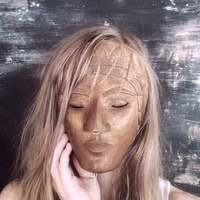
Or is it my country? Being a stranger, at home. (Bule di rumah.) Surrounded, protected, as by a wall, by recognition, but correspondence is at the same time unpredictable, wild. I am found to be several someones, then very, very many. (So many strangers.) At first this is difficult, but then (I can make it) effortless. Unknown, but contained, sometimes even possessed. And Ibuk will teach me to dance. (Mind-blowing.
)…(
Self-government by love, a good morning, and whatever else might be possible.) Well, time for practice.
Slanted sunlight breaks through steam. Limns wet edge of concrete, scatters in leftover droplets, catches ochre fur of hovering fly. Filters through yellowed leaf and turns it golden. East wind, wet and barely cool, carries news of oceans and exhaust. What’s not secured (dry leaves, a crumpled tissue) falls, is blown away.
Last night in Penestanan // Gamelan
strikes bronze and sounds of competition,
jumping (on) and fending (off) the night
time, momentum tops the kendang and
recedes, then tries again (again) elaboration
of champaca smoke on taught skin
low beats call up shining
density from darkness (Bima’s
laughing) and his pupils
follow moths at
lantern light
frenzy
dancing
Still raining, still dark, still soaked to the point of saturation. May the rain bring the world back from the loudly unspeakable, back from self-abstraction. Ghosts, being stuck in some in-between place, will eventually realize, (can ghosts learn?), that being (human and being) half there is not being there at all. Likewise, fifty percent of a world (any world, no matter how wealthy or free) is one hundred percent unlivable. So. The perennial question of who I am, (where to and where from), and today the answer, family is here. Listening to what is present as to what is quiet, my day will be full of smiles to return. (A living face, a secret to itself, is at least self-contained.) This (the daily slog of political theory
)…(
iykyk) becomes a certain happiness, necessarily. And sometimes there will be no other way.
(I almost put two contact lenses into the same eye, this morning.)

It’s a lot.
Chaotic maneuvers this morning after certain equipment, which had been broken for a long time, finally became unusable last night, ok I will tell you, the water kettle fell apart. The glue holding the plastic levered stopper to the aluminum body melted off or dissolved, and left a smear of melted black plastic on the pouring spout. (Yum.) I try not to be precious about the flimsy equipment standard in household shops here, people make do, and so have I. (I read that the risk of aluminum poisoning from cookware is largely exaggerated? And I trusted that information? Was that the right thing to do?) But I did think briefly, wistfully of the (stainless steel, sturdy, chic) ikea kettle that sits already in the new house, on an induction cooktop, (a luxury, no more running out of gas, or wrestling gas tanks and their beat-up valves, risking limbs for fuel for heat), and its dulcet whistle, a treasure to be used.
(I’ve become famous in the family for using kitchen tools hard and breaking them fast, blenders or stick-blenders especially. I demand performance! Not sure this is a good or bad thing, E. thinks it’s hilarious, is laughing this very minute, he says he gossips about it with other husbands. Possibly a point of pride, for him, I admit, it does reveal something enduring about my personality…)
Waking up and taking stock, this is about where we are. So ready to be gone from the guesthouse that inanimate things are kicking us out, refusing to function, telling us (me?) to leave. Family from Java (including Ibuk/mother-in-law) arrives tomorrow for yet another new house ceremony (Javanese) on Thursday, when we will move the cats and start living there for good. None of it is in my control. It feels similar to when we got married. Pulled up into a tidal wave of big-family customs and engagements, trying to hold my own (personal, petty) rhythms, hoping/assuming (cheerfully) I will be back on solid, more predictable ground soon, I just have to (go limp and) survive the next few days.
Rainy still, wet everywhere, and dark. I guess dry season got cancelled. Santai saja. (Let’s just be relaxed.)
For us. // A dark day, cold and rainy and the atmosphere got funereal for a minute, which it does here, now and again. My mother-in-law is passing away from dementia and my country sort of is also. There are parallels between the grieving processes, all of which I experience almost second-handedly, at unstable removes.
One of the things that makes it truly difficult is learning, through trial and (regrettable, yet forgivable) error, how softly you have to tread when it isn’t yet clear (to everyone, to anyone, at any given moment) that she is dying. How feelings of guilt, anger, fear, or sadness intermittently (and unpredictably) penetrate the (relief and) forgetfulness of daily activity. How one believes, (because belief is everything), (belief is her), until the moment it becomes impossible to believe, that she is not yet lost. And how that moment disarms us, completely, leaves us feeling motherless, without a home, (or seeming impossible to ourselves.
)…(
So I have a prayer, for us.) Bismillahir Rahmanir Raheem. May you never be alone in this. May you be surrounded by love and care. And may the people you have loved always be there to remind you that you are absolutely possible, solid, and real.

Wijaya kusuma (7). // Clarity.
Showering. A spider came dangling down from the ceiling, right in front of my face. A smooth spiderwoman drop, front legs raised in fearless poise. How graceful she was, descending into the steamy waterfall! The subsequent dance. (I imagine myself played by Kim Cattrall.) Me, nude, startled bonkers. She, versatile, evading my careful attempts, trying again with more elaborate gestures, to catch her by her thread. I failed. She lifted herself up and escaped into obscurity (the thatched bamboo ceiling).
The bathroom is where we keep a seminar of spiders. They are good at catching bugs and generating ideas.
Music is artificial intelligence. (Anyone who says differently is selling something.) (Or are themselves being sold.)
Beat on the kul-kul summons people to the pura this morning and gamelan starts for the ceremony. Incense smoking, offerings aloft, village is alert, decisive. Brass shivers and syncopated heartbeat and (bodies marching and) the bell of the Mangku, high and bright. All attention put on the spirit. Barong moves through the streets today, transportation by music, in full regalia. (The battle for balance. Stops traffic, stops everything. Alhamdulillah. And what are you being called to do?)
Beginning again with a tentative rhythm. Afternoon sun, slanted, partial, and hot, with persimmons on the kitchen counter. Irregular spheres, some squat or approaching rounded-square, pale orange or chartreuse waxy skin speckled and clouded with powdery must. I choose three. Stemleaf (calyx) thickly coated, looking ancient. Paring knife separates (as a broken spiral, drops) skin from clean flesh inside, cut open, with octagonally-spoked slivers for (not there) seeds. Firm between teeth, shifts to pulpy softness, floral honey sweet, young and complicated with something nostalgic. A fragrance from childhood candy. Games of pure pleasure being just out of reach.

Wijaya kusuma (6). // Indecision.
I found the Margaret spoon when I was packing the wardrobe, I mentioned it to my mother and she was reminiscing about her grandmother (Margaret). How she would play the piano and sing, and her grandfather would sing too, and their “beautiful voices”. She (my mom) remembered that from when she was six years old. (In my imagination, she plays lieder by Franz Schubert, I listen to it now.) Margaret was also an amateur astronomer, which has me thinking about studying constellations. It’s often too cloudy here for stars.
Cloudy again tonight, and raining, and the sky is an inky thickness. They sit around a cross-section of tree, cigarette packs out, kripik passed. Low conversation. Light bullying. A start, a decision, not quite unanimous, to go on the roof. Bare feet up homemade ladders, disembodied voices, and the night tips over that always close-by edge into surreality.
Under rain again. Big grey above, sucking sponge beneath, birdcall from all corners. Everyone wants to speak. (Good morning, Frankie.) Knowledge and being known across distance, sound as comprehension. (And what is it you say?) Crowing. A sometime slow sheen, passing in and out of soaking pour, dry under roofs, (mostly), we let the weather check for leaks. You will not know a house until it rains ten-thousand times. (Numbers become abstract, here.) House logic, according to which, demonstration is a demonstration. (And everything is fixable, including you.) Solid structure carries watery indeterminate around the sweet space of human habitation. (A house being clear and present negation.) Emptiness is also comprehension. Toes cold, eyes blinking open, coffee is fire.
Emptying the wardrobe. // (Finally.) Piece by piece sorting clothes (and other things) into (commandeered from cats) cardboard boxes. Items that disappeared, (underclothes, mostly), constantly needed and vaguely missed, one by one reappear, having been crumpled into rear corners, crevices, hiding between darker and heavier things. One could have sworn one had checked there, again and again. Some coated in dusty grey mold, some apparently eaten by it, elastics and polyester blends stiffened or dissolved or having become oddly, unpleasantly sticky in the dank incubator, black box, organizer’s nemesis, which has in certain ways ruled over us these past years, determining what we were allowed to have, and what not. You see, the tropical climate is unsuited to long-term storage (or possession) of anything at all (subject to disintegration).
(Avoiding questions, whether we could have been happier here, if we had done this all a little bit differently.) (We came to the guesthouse in February 2020. Having no idea what was about to happen, of course we stayed much longer than planned.)
The satisfaction of shining light on the interior of a more-or-less orthogonal container. Hollow. An empty possibility, belonging soon to somebody else. Sketching boundaries between ourselves and whatever will become of that.

Wijaya kusuma (5). // Not yet.
Paranormal. // Beady black ants, small and matte and anonymous-looking, crowd around some coconut water spilled on the kitchen counter, dropped crumbs on the floor, bits of sugar in a saucer, anything oily, and a small river of them courses around the perimeter of the kitchen, spilling out as a black swarm on the catfood dish. Flowing. It rained for a minute, night releasing a sigh. Now the air cools from evaporation off leaves wet and shiny in the dark. Walking outside to refill a glass, I see movement in the corner of my eye. A shadow that defies looking. Might be a ghost.
Different ants have different signals to make them go away. “Earthquake”, we tap or shake a plate, they file away, we can wash the dish. Or “typhoon”, we blow on the plate, they scatter and go, we can wash the dish. Beady black ants don’t have a signal. We tap the dish, blow on it, they spread, but they don’t leave or even disperse very much. They run around in panic circles. E. blows tobacco smoke, “forest fire”, as last resort. They don’t clear away. Can’t wash a dish or clean the counter without wiping multitudes up or putting them down the drain. They stick to dishes, even under running water. And they crawl onto anything, when upset, hands, tissues, bare feet, cats. Not aggressive, but fast, and when you accidentally squish one, the bite is a pink welt that itches and hurts for three or four days. We find them crawling on us, biting us, in our clothes, in our bed at night, in our food dishes. Pinch it off, toss on the ground. A moving blur on a glasses lense. Ant.
(The rain these past days isn’t normal, for this time of year. The ants, displaced by the rain, are not normal. A ghost that I saw in the kitchen is… more normal than the ants.)
An interesting thing, about (poetry, and) prayer, is how it can’t be reverse engineered. (Pretty sure, and as always, Aristotle points out something similar in the Poetics, using terms almost im/possible to translate.)