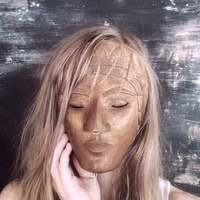
Phaedrus

    Socrates: (cont.) And as the lover (erastes) of words was begging him to speak, he broke away, as if it was not his desire (epithume-o) to speak—

    // 228β

    δεομένου δὲ λέγειν τοῦ τῶν λόγων ἐραστοῦ, ἐθρύπτετο ὡς δὴ οὐκ ἐπιθυμῶν λέγειν

    //

    Gold. Beef? //

    silver tongue,
    golden ear,
    Lover absent,
    garden near—

    The title of this poem is homonymous with my husband’s name.

    This poem, from further back, has a pretty obvious W. B. Yeats reference that I forgot to mention. “Sailing to Byzantium” is an old favorite of everybody’s, including mine. I feel like I understand it differently now than when I first read it, ~25 years ago.

    I love Yeats and would never write against him on purpose. But “Military Parade” does express a reversal; and then I noticed how “Sailing to Byzantium”, with its explicit goldsmithery, is roughly opposite to “Begging Season”, which is earthy and humble, in material, scale, texture. And then I noticed . . . how consistently not-gold my poetry is, where gold is postponed, doubted, displaced. Even my homonymous husband poem rejects its golden ring. A cascade of questions followed, beginning with: Whence the pattern? It wasn’t quite calculated. Things just seemed true at the time.

    Am I weird about gold? Why? How did I get that way?

    If I wrote more gold poetry, would I attract more mean green ($)?

    A mischievous question like that is based on an esoteric, witchcrafty mode that Yeats and I share, by lineage (his being mine, and he being part of mine). I don’t dismiss the utility of mantra. And I wouldn’t put it past him, to craft gold into presence. So. Could I write a gold poem? Should I? What would mine be?

    Finding in myself no poem of gold—Is this (would Yeats say) a sign that I lack imaginative ambition, symbolic understanding, spiritual daring?

    Gold does appear, in my crafted imagination, my images and dreams, but rarely is its presence pure or simple. The negation—an optical or organic filtering—of gold feels important to me. It certainly reflects a material condition; I see little gold in my day-to-day. Does it also express a worthy poetic commitment, to limit gold’s presence—to the very limits?

    . . . Do I have (vegan) beef with Yeats?

    Consider my family, friends, and allies. What is the meaning of gold, in my community? How does gold function in poetry—mine, others'? Commence a catalogue of golden ships. (Fascinating, for sure; forthcoming, maybe—this would be an amazing list. I have a certain intuition that Phaedrus will back me up; and Socrates never would, but the Republic—seminal, in this respect—experiments with pure, psycho-political gold.)

    Does the meaning of gold change based on history? Upon witnessing newer distortions—the cruel and tacky deployment of gold, the dictator’s ballroom, the ecocidal tyranny of it all—would Yeats himself admit symbolic defeat? (Doubtful.)

    Or is there a—poetic, erotic, alchemical, theological—gold standard? Is gold truer than history?

    The narrator frames himself as a refugee, sick with desire and bereft of self-knowledge. He is not unlike the beggar. He calls upon sages—emergent from God’s holy fire!—to teach him how to sing. He remakes his own body out of gold, and Byzantium—like a halfway house of gold birds on golden boughs—becomes his artificial refuge. The lords and ladies of Byzantium are his final, appreciative audience. He entertains them with gold-wrought songs of the very world—natural, historical—that he has fled.

    The narrator is rescued from nature by his own luxuriant hypothesis, this golden ear. Wonderfully, he has crafted his savior into presence. And it might be us. But let’s be honest—was a poet ever rescued by gold?

    Or does a poet set out to rescue gold?

    . . . To rescue gold, from what?

    I believe these are deep and important questions, all of which touch on power and the image. I also observe that questions of gold, not unlike worlds of gold, initiate a seduction. Yeats’ poem embodies the transcendent height of a poetic (symbolic, alchemical, technological) fantasy, rescuing as it escapes. While my senses slip ever so comfortably into gold’s embrace.

    I see the allure . . . and it feels like a rub.

    //

    See also: this reply from Angles Morts.

    Socrates: (cont.) And meeting one mad for hearing words, and seeing him, seeing, it would pleasure him to possess a fellow Corybantic reveler, and he commanded him to lead—

    // 228β

    ἀπαντήσας δὲ τῷ νοσοῦντι περὶ λόγων ἀκοήν, ἰδὼν μέν ἰδών, ἥσθη ὅτι ἕξοι τὸν συγκορυβαντιῶντα, καὶ προάγειν ἐκέλευε

    //

    “Then,” he said, “O Simmias, those rightly loving wisdom practice (meleta-o) death, and dying is least fearful for those, among humans."

    // Phaedo 67ε

    If Phaedrus sits between Phaedo, whose act is the death of philosophy, and Timaeus, whose act is full creative flight—then Phaedrus is the birth and fledging of the poet. It accomplishes the transformation from interior to exterior by way of externalized interiority. It demonstrates the containment of love in a poem; its success rests on Socrates’ closing prayer.

    Practicing death (as previously mentioned) is reborn as studying and writing poetry. In this, the pharmakon becomes a necessary tool—like a eucharist, hence the prayer. The pharmakon both kills and resurrects.

    O beloved Phaedrus, whereto and wherefrom?

    hypothesis : the second sailing :: pharmakon : Platonic poetics . . . :: demiurge : cosmos.

    Socrates: (cont.) And he crossed outside the wall, that he might practice (meleta-o).

    // [228β]

    ἐπορεύετο δ᾽ ἐκτὸς τείχους ἵνα μελετῴη

    //

    Socrates: (cont.)

    and doing this, sitting since early morning
    he gave it up and went for a walk — knowing
    the speech thoroughly, i would guess, by the dog

    unless it is very long indeed

    // 228β

    καὶ τοῦτο δρῶν ἐξ ἑωθινοῦ καθήμενος ἀπειπὼν εἰς περίπατον ᾔει, ὡς μὲν ἐγὼ οἶμαι, νὴ τὸν κύνα, ἐξεπιστάμενος τὸν λόγον

    εἰ μὴ πάνυ τι ἦν μακρός

    //

    Lessons from the puputan

    cw: (historical) political violence and suicide.

    Another passage from Revolusi (David van Reybrouck), on the Balinese puputan of the early 1900s:

    “More horrifying still were the scenes in Bali, where in 1906 and 1908 the complete courts of a number of principalities chose to commit collective suicide (puputan). Hundreds of men, women and even children walked straight towards the Dutch rifles and artillery. They were dressed in traditional white garments and carried only staffs, spears and the finely wrought traditional daggers called krises. ‘The rat-a-tat-tat of gunfire went on, the fighting grew fiercer, people fell on top of each other and more and more blood flowed.’ A pregnant Balinese woman was one of the few who lived to tell the tale. ‘Persisting in passionate fury, men and women advanced, standing up for the truth without fear, to protect their country of birth, willing to lay down their lives.’ The KNIL [Dutch] soldiers couldn’t believe their eyes: women hurled their jewellery at them mockingly, courtiers stabbed themselves with their daggers and died, men were mown down by cannons. The wounded were put out of their misery by their relatives, who were killed in turn by the Dutch bullets. Then the colonial army plundered the corpses. In the puputan of 1906, an estimated 3,000 people died. ‘The battlefield was completely silent, aside from the rasp of dying breath and the cries for help heard from among the bodies.’

    “And this event, too, has left traces. In December 2017 I travelled around a near-deserted Bali. Mount Agung’s volcanic rumblings had put a stop to tourism for the time being, and in the ancient capital of Klungkung, I found the desolate ruin of the royal palace. It had been destroyed after the puputan of 1908. ‘My grandpa, Dewa Agung Oka Geg, was there that day,’ said Tjokorda Gde Agung Samara Wicaksana, the crown prince of Klungkung. We were sitting in the new palace, opposite the ruin, and drinking tea. It was Saturday and his servants had gone home; he had made the tea himself. ‘The puputan of Klungkung was the very last one. After that, Bali was entirely subject to Dutch authority. My grandfather was only thirteen years old and nephew to the king.’ Almost the entire royal family died; the king and the first prince in the line of succession were killed, the king’s six wives stabbed themselves to death with krises, and 200 courtiers followed their example or were murdered. ‘But my grandpa survived.'”

    It isn’t emphasized in front of tourists—the hedonistic hordes landing on Bali every day, who come for sprawling villas, endless traffic jams, cheap labor, and the monetization and destruction of the island’s natural and cultural resources. But the Balinese valiantly, fiercely resisted Dutch colonial control. They did so, notably, by puputan.

    I’m not sure it would make any difference, if tourists were universally informed about the puputan. The days even of pretense seem to be gone. Ubud has transformed into an urban shopping complex, bloated by money, overrun by beach bodies. We rarely go there anymore, the traffic and high prices make it inaccessible. Locals have converted family homes to expensive boutiques, restaurants, and villas. Foreign-catering establishments occupy an upper echelon of public space, not unlike colonial resorts in the Dutch East Indies. These fantasy realms are inaccessible and undesirable to most working-class Indonesians, whose labor builds them, whose work is to wait on and serve the foreigners. Ubud, like Canggu and Kuta before it, has been smothered by gentrification.

    But my fantasy is that everyone is always remembering the puputan. These acts of solidarity are still alive—I know it—deep in the meaning of this island. We, following the Balinese, make offerings to the ancestors, in a sangga at our house, to show that we remember. And the mountain holds the memory.

    The puputan are a testament to a people and a place.

    //

    Now, Love—An abrupt change of topic? no—Love is difficult. I’m not sure it’s possible to love, outside of a context such as this.

    In my life, I have found it difficult to feel contentment in love. As soon as I feel a moment of contentment, I watch it happen—I’m gripped with terror at the thought that my beloved will die and be lost to me forever. I’m inundated by images of death—mine, his, that unthinkable loss. Love is terrifying because loss is terrifying.

    My husband (E) has always stated, plainly, his conviction that he will be there waiting for me, in the next life, and that we will live, in the afterlife, together forever. This is the deal, the very basis of our marriage—our marriage is truer than death. And it lends courage to love.

    I say to myself—“You needed to find someone who believed in monsters, to find someone who could believe in you.” Well, E was that person. He believes. Drunk off his imaginative capacity, I stopped disbelieving too. So at our house, we believe in Wewe Gombel, Kuntilanak, Tuyul, and countless others. There are more monsters and ghouls and djin and demons and mer-folk than I ever expected. It’s amazing. I believe in all of them!

    And if I ever feel a moment of cleverness, superiority, or doubt, concerning the reality of a ghost or spirit, I remember—I myself am the most dubious of all. I am, very truly, the dubious one! It’s a miraculous kind of bargain. I suspend disbelief in Wewe Gombel, and I suspend disbelief in myself. I couldn’t do it without E, I’d never heard of Wewe Gombel before him.

    That’s the grim overtone to a deeper harmony. What I also needed, was not just someone who believed in monsters, but someone who believed in mercy. I had booksmarts coming out of my eyeballs, but I didn’t know anything about mercy, until I met my husband. Mercy, itself a kind of monstrous irrationality, had also been unbelievable to me.

    //

    Cut to the dialogue, Plato’s Phaedrus. A relevant passage comes later in the text than where I am now. And yet the text is simultaneous with itself (unlike the blog). Here, it pierces into the beating heart. To paraphrase, from memory—and I’ll stop vouching for accuracy here, because why should I?—Socrates says he has no time for a skeptical inquisition against mythical beings, as being true or false, fact or fiction. His Wewe Gombel is Boreas, the North Wind, storied to have abducted Oreithyia, a maiden princess. He has no time, because he doesn’t yet know, of himself, whether he is full of rage, like a Typhon, or capable of mercy, partaking in the divine.

    The imperative, more urgent than doubt, is of divine provenance—Know thyself—and credited to the oracle at Delphi.

    The dialogue, having arrived at its poetically designated place—in the shade of a platanos tree—hints at things: that Socrates is, in his living truth, a mythical being; that Socrates is a character in a poem, of dubious reality; that Socrates is a monster. If Socrates doesn’t know, then how would we? Did, or does, the poet know? And if I fail to know Socrates, shall I forget myself?

    Maybe so. And if I am so unsure of myself, then by what desire and on what grounds shall I interrogate the truth of anything else? Am I only a monster, for monsters, reading a monstrous poem, written by a monster, about monsters?

    Is it monsters at war, this very poem, or is it a creature of mercy?

    These become inevitable and appropriate questions in this dramatic context, as Socrates and Phaedrus have left Athens. They have exited the city walls, in a poem that was written, historically, not long after Athens was defeated by Sparta and overtaken by the thirty tyrants; not long after Athens put Socrates on trial and killed him. That death also was a kind of suicide. And history bleeds into the poem.

    Now, we find ourselves in a lovely fantasy—is it the poet’s? Socrates and Phaedrus, for the purpose of the poem, are leisurely wanderers, or an infatuated lover pursuing his flighty beloved (two competing interpretations of the same dramatic action), beyond an unstable and oppressive political reality.

    And look—the questions out here are different than the ones in there.

    If the city serves as a container for self-knowledge, in the form of Justice, Virtue, or even the Good, what happens when you leave that container? How does anybody leave behind their city, and its laws, without becoming utterly lost? And what when the city crumbles, and a person survives? What basis is there for self-knowledge, if a human being is, as in this paradisical afterlife of the poem, an on the way thing?

    This question of human nature reflects the personal identity of the poet—exiled, abroad, otherwise absent—from a failing democracy. When there is no city to support or to limit you; when the laws have lost their definitive hold, by unlikely accident, a miracle, an error in your favor; or when they have destroyed the very foundation of their claim to Justice—who or what might you become? What is left for you to be?

    And why would you carry this poem in your pocket?

    //

    My husband and I have a pair of matched krises, these sacred daggers. They were passed down to E through his grandfather. Each has a wood sheath carved around it. These are ceremonial krises, not big dangerous daggers. And still, they feel heavier in the hand from the steel inside. His is smooth and broad, with a face like an inquisitive fish. Mine—witch-made, I am told, specifically for a woman—is sheathed in sandalwood, shaped like a bodkin, with a slender, split hoof at the end of the handle. E gave it to me after we married. I had a general idea of their meaning, like an athame. But I had never made the connection with puputan.

    My kris fell into my lap, as these things do. Now it sits in my bedside table, mundanely inherited, more-or-less imposing its presence. Now, who is the instrument of whom?

    Histories are alive with mythical animals. Always on the way, through wildernesses, we glimpse clearer selves—ours, theirs; past, present. Lightning flashes as responsibility in the dark. We follow the shining; that is love. We are seized by the wind, over edges of cliffs, bearing witness—to what? As unable to save others, as we are ourselves, we become unknown, are dead and gone, living among immortals. Any of these, or all.

    So the pen takes lessons from the puputan. A kris is an instrument of truth as freedom, the life of exit, wholeness through cutting. The blade makes a container for the uncontained. Clad in white, tossing its jewels at tyrants, bleeding itself into self-possession—

    Poetry is the puputan of logos.

    //

    Socrates: (cont.) But even that wasn’t enough. And he, managing to take possession of the book, examined what his heart most desired (epithumos).

    // 228β

    τῷ δὲ οὐδὲ ταῦτα ἦν ἱκανά, ἀλλὰ τελευτῶν παραλαβὼν τὸ βιβλίον ἃ μάλιστα ἐπεθύμει ἐπεσκόπει

    //

    Socrates: (cont.) Well do I know, that when he heard Lysias' speech, he didn’t hear it only once. But often and repeatedly, Phaedrus urged him to speak. And Lysias eagerly (prothumos) obliged.

    // 228α-228β

    εὖ οἶδα ὅτι Λυσίου λόγον ἀκούων ἐκεῖνος οὐ μόνον ἅπαξ ἤκουσεν, ἀλλὰ πολλάκις ἐπαναλαμβάνων ἐκέλευέν οἱ λέγειν, ὁ δὲ ἐπείθετο προθύμως

    //

    Socrates: (cont.) and yet, ( i have done ) neither of these.

    // 228α

    ἀλλὰ γὰρ οὐδέτερά ἐστι τούτων

    //

    Socrates: O Phaedrus—if i fail to know my Phaedrus, i have forgotten my own self.

    // 228α

    ὦ Φαῖδρε, εἰ ἐγὼ Φαῖδρον ἀγνοῶ, καὶ ἐμαυτοῦ ἐπιλέλησμαι

    //

    Phaedrus: what could you mean, O best Socrates? when Lysias, who is the cleverest (deinos) of contemporary writers, composed it over a long time, and at his leisure; while i’m just—any old body—(idiotes)—

    how could i remember this, in a way worthy of that ?

    so i lack, abundantly; and yet, i’d want to— more than much gold becoming mine.

    // 227δ-228α

    Soc.: (cont.) nonetheless, i set my heart’s desire (thumos) on hearing. so even if you, walking, made your walkabout to Megara, and like Herodicus came to the wall and departed again, i still would not leave your side. // 227δ

    Socrates: O the genius. if only he would write that for the poor man rather than the rich, and the older rather than the younger, and for whatever else is attached to me and the many of us; then the words would really be popular and publicly useful. // 227ξ

    Phaedrus: indeed Socrates, and the hearing relates to you; for the account was — of our spending, somehow, i don’t know — erotic; for Lysias has written the temptation (peirein) of a beauty; but not by a lover (erastes), this is his very subtlety — he says one must gratify (charisteos/charizomai) one who is not a lover, rather than a lover (era-o)

    // 227ξ

    καὶ μήν, ὦ Σώκρατες, προσήκουσα γέ σοι ἡ ἀκοή: ὁ γάρ τοι λόγος ἦν, περὶ ὃν διετρίβομεν, οὐκ οἶδ᾽ ὅντινα τρόπον ἐρωτικός. γέγραφε γὰρ δὴ ὁ Λυσίας πειρώμενόν τινα τῶν καλῶν, οὐχ ὑπ᾽ ἐραστοῦ δέ, ἀλλ᾽ αὐτὸ δὴ τοῦτο καὶ κεκόμψευται: λέγει γὰρ ὡς χαριστέον μὴ ἐρῶντι μᾶλλον ἢ ἐρῶντι

    //

    Socrates: O beloved (philos) Phaedrus, whereto and wherefrom?

    Phaedrus: from Lysias, Socrates, son of Cephalus, and i am going (poreuein) for a walk (peripatos) outside the wall

    for i spent a long time there, sitting since early morning

    persuaded by your fellow and mine, Acumenus, i make (poieein) my walkabout along the paths; he says they remedy weariness better than the racetracks

    Socrates: beautifully said, O fellow; but it seems Lysias was in town

    Phaedrus: yes, at Epicrates', the house of Morychus near the Olympian temple

    Socrates: so what was the spending? or obviously Lysias was feasting you with speeches?

    Phaedrus: you will learn, if you have leisure (schole) to hear as you go

    Socrates: what, don’t you think i make it, as Pindar says, “a matter higher even than business” (a-scholias) to hear about your and Lysias' spending?

    Phaedrus: then lead

    Socrates: and speak

    // 227α-β

    silver robes of a rose rabbi

    (This 12-part poem is a reply to Wallace Stevens’ “Le Monocle de Mon Oncle”; Further explanation may be found here.)


    I.

    —and did you ordinary women mock
    in liturgies of utterances contained,
    lines overwrought by time-keeping cant of yours?
    and did you burst from bullied syllabub,
    or clockwise stiffen into winter walls?
    the musicals of ghosts, midwives and angels
    echo, hollow, down stone-cold corridors.
    and did you consecrate your spectacle,
    coupling one who spoke—no, no—not nothing,
    a stand-in that you killed while playing swords?
    to quell the babbling spring by means of rain,
    or merely quote the Mother’s name in vain?

    she has been up at nights, considering
    how to un-kiss this devil-gendered thing.


    II.

    well, i make believe an uncle, dead
    and dear. less clear is fortune of the bird.
    to fly, to seek, and what on earth to find
    but torrent of an obsolescent mind
    —he said, obscure and arduous to hear.
    and yet, it flies. and though he doubts her crown
    and midnight sight, she will fly too. and though
    her silver glows in anecdotal mood,
    her lilt, of stellar tilt, still loving, lingers
    in braided dancing round a pool of blue,
    tuning her clutch in nesting eddy of
    said bird, whose course is old and hardly true—
    and yet, it lives. rising, as golden-red
    in flight, crowing like Scorpio in the East.

    rest easy, uncle cold and fluttering
    and lately of rambunctious residue;
    a dove survives heaven to choir anew.


    III.

    O man, if you could see her witchlocs now,
    or what’s become of Eastern expertise.
    she is swamp-bitch, and twisted, twined and hitched
    without romance by ruby claw to thorny crown,
    her hair—each barb a bell, each bloody herb
    a suicide. she’s heard of nobody’s
    outrageous feats of raw technology.
    in wracked rumors of Western fantasy
    she knit a while textiles anti-exotic,
    but sweaters have no use in the tropics,
    where skin is king. and now we’ve come uncrimped,
    uncrumpling, algal Anadyomene
    of muddy water, Charybdis of the bog.

    what’s history is past—nevertheless, he asks
    why, woman, have you gone au naturel?


    IV.

    that spotless glass is not the book of Adam.
    that trinity you stole cuts like a knife.
    to be uncrumpled is to be un-uncled—
    un-uncled, i become the poet’s wife.

    i am un-hidden woman of the garden,
    body un-ridden by the dust-bound word.
    the queen of poet’s tongue, i lounge and lean
    as music on my salivary throne.

    the syllable you speak, my roundness is
    her shapely immanence. our rectitude
    is life—of tree—of life. so eat me, fallen
    father of mankind, and know your foolishness.

    speak again, brother—madly, as husband.
    my honeyed bone un-spells your make-believe
    kafir—he sees his wife sans négligee
    who tastes the ripened fruit by naked eye.

    says ordinary woman made explicit,
    who steals your spectacle to save your life.


    V.

    can we remember together, after all
    or does my voice harden the picture frame?
    by being body, do i gather you
    intolerably, or spread you thin as kin,
    one stroking throb of summer esoteric—
    you tickle me with feather of a peacock.
    a gazer’s gloomy imagery is perfume
    of incense, arousal at great distances,
    long-smouldering and lit by tender match.
    far from the proximity of virgins
    there burn the Verbs of Love, arrayed
    as galaxy of irretrievability—
    before my eyes, you took and held my hand.


    VI.

    we used to call you man of twists and turns,
    the dynamo—reckless, drowning, sea-rendered
    until perennial blue, the one i knew
    well enough to know, i loved nobody.
    his thirst, prostrated, clutched me from below,
    desperate to conceal from wingèd word
    a history of suffering. a babe
    buried his need in bosom of my nature,
    drunk on the deep milk of disappearance.
    his subterfuge despair was mythical,
    until he made her fiction. he may not
    remember me—but i keep by my heart
    a wavy lock of sunset-auburn hair.


    VII.

    suppose a parable is just like her:
    desired and defiled in equal measure.
    his chivalry requires a blushing knight
    to guard the Word, who is incarnate treasure.

    i heard of one such rescuer of women.
    who, for his lovely sin, was de-mountained
    by crippled foot, and fated never nimbly
    to climb again. but faith in constancy
    makes deliberate gifts, arms built from hours
    spent torquing tongs before roaring earth-core.
    therefore, no purity of heart is borne
    that lacks an alloy in the sooty forge.

    thou shalt not fear the courage of your virgin,
    is the limping gist of this comparison;
    her shining is at once translucent bloom
    and armor’s lustre, welded by humble Vulcan.


    VIII.

    if doom begins to seem antipathy,
    baby, you’re scrolling past the blues. that time
    of year thou mayst in our humanity—
    but not the Muse—behold, of warty gourds'

    cosmic grotesquerie. and there’s the rub.
    as long as tongue still holds a gentle fold,
    i will elucidate your grim hallucination.
    launder and bandage the decaying limb

    of sense, of memory, of time. wed heaps
    of conscious compost consummate the bloom
    in star-swept dimensions of titanium,
    where whorls of microplastics never end—

    machine poetic, of pumpkins meteoric,
    becoming metaphysic—tender beings,
    fizzing histories apocalyptic,
    chime and rhyme as flutes of pink kombucha.

    we sing the tropical-epochal view
    at end of universe, or two. until
    séance à trois, with chaperone of grackle,
    i love the laughing sky—let’s make it crackle.


    IX.

    most oblatory heart, i bring you news.
    despite our deadly faith in prophylactics,
    resourceful Cupido pricks porous tactics,
    ever hanging hymenal fools. behold:

    on spun-gold surface of radiant yolk,
    in sky-strewn milky way of albumen
    suspended, questing’s lustiest conceit,
    the part-less heartbeat of a person third:

    as ancient aspect touches youngest plume
    to stir, pure destiny, the origin
    of life, as love, in pilgrimage secured:
    the red point points, and to itself—as bird.

    O holy gift, O crack in everything!
    the mad midwifery of paladins
    births not a baby, but a voice on fire:
    ecce peep. now go, and meet your daddy-o.

    his name’s Pipit the cocky chickadee;
    he is a theory of fertility;
    enthusiasm incommensurate
    with clock-a tweedle-dee and tweedle-dum.


    X.

    a balmy chickadee alights on bough
    of jepun tree—gigantic, bristle-trunked,
    beatified—by tipped cosmos of day
    and melting star of paradise, bodies
    unveiled. we lie in kindred shades of them,
    verbing and flowing, in blues made legible
    by greenborn leaf. in leaves there hides a forest
    where braid the wanderers their briared maths.
    a souvenir shelters nectonic paths,
    ancestral courses wild with counterpoint,
    and mercy of geometry—proffered
    by rivered children of Love’s oblivion.


    XI.

    dilated pools, star-gazed—surrender pinkly
    to phobia of frogs. if you dismember
    those bracing, faceless bodies—lost in love
    their coiling gyres, desiring—helixing
    directions inward, home. or intervene
    against the skyward cough—raw, gaping need
    to swallow more—when pollywog is strung
    by lunar air. ritual drowning of gills,
    suffering insurgency—the gulping word,
    fata Morgana flooding Camelot
    is twinned ecstasy of triple betrayal.
    for swimmers' lust, the sea is all. and still

    her cries are not for us, alone—we hone
    the bluest chord of velvet-driven reverberation.


    XII.

    now all of us have lost our taste for mince,
    the history of grinding, darkly, Adam;
    so schooling blade, student of buah, prunes
    til circumspect the hour. and she has thorns,
    forms of her own—we prick ourselves and bleed
    to name her flower. bending the voice to crown,
    we’re drunk by literal skies of melody.
    you found her singing by the sea, where she
    had fled, as she remembered you were drowning.
    who is the rose rabbi? i read, she comes
    and goes. knows herself not. how would she know?
    if glass were introspect, Iris of time—
    to find she had been borne, a cradled question.


    //

    🌕

    a pewter chest for the silver robes

    already i have sensed murmurations of moving on. and i’ve hesitated. but it’s time to bundle these up in ribbons so that they might go home. ( what follows is an introduction to “silver robes of a rose rabbi”, a cycle of poems i will post on purnama, InsyaAllah. and the closing of a chapter. )

    telescopic texts” were born as serial replies to the twelve cantos of Wallace Stevens' “Le Monocle de Mon Oncle”. i stumbled into this project and was amazed at their unfolding, at the responsiveness of Stevens' text to this treatment, and at the fruitfulness of a dynamic interaction. furthermore, it became apparent this was exactly the initiation needed for this blog’s translation of Plato’s Phaedrus. ( things come together and open up in a wonderful way. )

    “translation of the Phaedrus” — is “translation” the right word? for the sake of transparency: i’m not setting the rules; i am caught in a vast body of waves. flotsam is pulled in, cobbled together, sent away, before i have fully understood. this is embarrassing in all of the ways that “Mon Oncle” is embarrassed by its own sublime. ( by Love, as mantically bashful poetry, which opens into stratospheres. )

    here, “Mon Oncle” has constituted an epicycle of Phaedrus. a poem is a gravitational pool to suck you in and spit you out as something ( or somewhere ) different. i go along for rides and things are created thereby. drunkenness is a confession, not a metaphor. it’s like losing everything, but then it’s the blues. InsyaAllah there will be more poems of insanity, madness, mania — the alchemical reduction to metered speech. ( pores of the poem, through which rivers flow back into the poet’s seed. and rivers will be the madness. )

    but madness isn’t a method in itself, so i maintain that this is a translation. carrying bones is part of building a temple, even when the temple is something inconsequential like a blog. building a temple has from the beginning been the generative dream of this blog. ( a temple needs orientation toward Mecca, that stone among stones. )

    a note on my process. in translating the text of Phaedrus, i had reached the end of a dialectical prelude. it was time to wrap something up, and time to get something started. there was an aperture into a dream. it demanded initiation. ( and/or it commanded leisure. ) Pindar was the first step, and a chariot was born, but i needed more contemporary tuning, more techniques, lenses, experience with my vernacular. ( i needed a voice; i dawdled at the crossroads. )

    i was re-reading Wallace Stevens. his later poems captivated me when i was in college — especially “The Idea of Order at Key West” and “The World as Meditation”. moreover, they changed the way I read Homer. so they changed the way i read everything. ( before i ever imagined writing poetry myself. ) now i wanted to discover clues as to how Uncle Wallace had built his voice. so I was studying his earliest book of poetry, Harmonium, when i was pulled by the aforementioned gravitational force into “Le Monocle”. ( there occurred a fertility ritual; and a certain birth. )

    so were created “silver robes of a rose rabbi”. i have seen and experienced so much in writing these — figuring them out, in, and around, being a poet of paltry months, with everything to learn. in case it doesn’t come across in the work itself: i have nothing but admiration and gratitude for Stevens' poetry. ( this has been an act of devotion.

    and well, the text mistook itself for vestments. )

    (

    one final note. as i write this blog, i continue ( slowly ) to study the Quran. to speak of rivers flowing and gravitation — i have a “deep hunch” that the Quran is a poetic singularity. if so, then i’ll spend the remainder of my life ( slowly ) learning to read it. as i have spent up until now ( slowly ) learning to read. i do not understand this as being in conflict with my ( slowly ) translation of Phaedrus. so poetry ( slowly ) becomes a choir.

    if a beginner voice, moreso a beginner listener. the first words of the Quran have begun to feel like sipping a trickle of fire out from underneath an immense ocean. for the sake of transparency. any light in these verses is from Allah through the intercession of the Messenger ﷺ. errors and mistakes are my own by the Mercy of Allah. Alhamdulillahirrabilalameen. Ar-Rahman Ar-Rahim. Wasalamu’alaikum to those i know and those i don’t know. Peace and thank you for reading🙏🏻

    )

    //

    Æ.3

    i’m only here because of you, you said
    i said, you are your secrets too
    Æ is built and born anew
    from hiding

    Phaedrus loves
    to hide so grow
    from hiding

    //

    if leisure

    (Phaedrus 227β)

    if leisure in the morning

    then spare me a glance

    if leaf-buds are forming

    then we have a chance


    if dew-drops are adorning

    then the roses free

    if leisure in the morning

    you’ll also have me


    if dreaming at noon

    let’s meet in the shade

    if weary come june

    then put down your spade


    if love is a simple tune

    and laughter the key

    if dreaming at noon

    you’ll also have me


    if easy in the evening

    then let’s read a book

    if lazy to be reasoning

    come hide in your nook


    if candle flame is flickering

    close your eyes and see

    if easy in the evening

    you’ll also have me


    if longing at midnight

    go walking on the sand

    if reaching for moonlight

    you will hold my hand


    if starlight is the invite

    sing beyond the sea

    if longing at midnight

    you’ll also have me


    //

    Assalamu’alaikumwarahmatullahiwabarakatuh 🌔

← Newer Posts Older Posts →