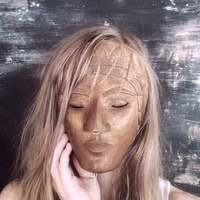
Naysayer (Kuntilanak nest in a bamboo forest)
This nascent key would never be a song;
Of roaring cells, erasing histories
Of sound, before the cradle’s founding hush.
Where ink blot habitats, mossy and lush,
Mothered, she organized her room: a game
Of pyramids, a smear of runs and zeroes.
In attics to indifferent infinities,
Neptune left mysteries troubled remains.
A child bride was famished for the truth—
I have no nasi. My broken bone sembako
For pakis, spiral shoots of wooly fern,
Blue-rumored eyes, intransigent bamboo.
Go back again, return to your first time.
This bed presents impossible as sin:
Crossed limb, grown gravity’s unsupple twin,
And sun impenetrant, absent the rhyme.
Be quiet as the grove, posthumous ration.
What lyre was greener than an arrow, slow
As pain, and dense as destiny—known knot,
No cut chords through your circumnavigation.
//
. . .
//
(santai; good leavening could make a year)
naysayer //
I was thinkin' about turquoise, I was thinkin' about gold //
I was thinkin’ about diamonds and the world’s biggest necklace
As we rode through the canyons, through the devilish cold
I was thinkin’ about Isis, how she thought I was so reckless
Bob Dylan // “Isis”
One of my favorite songs from one of my favorite Dylan albums. All that thinkin' ends up just thoughts, of course, other than Isis. The song builds a world and tears it down, in its heart an unmarked grave, and as its whole a mystical lovers' reunion. The gold here is part of its central deception. At the Rolling Thunder Revue, Bob says “this is a song about marriage” (song begins around 19:00). Of course it is.
Over the past few days, motivated by ideas from this post, I’ve been caught in the lyrics, melodies, and moods of gold-mentions from my favorite songwriters. These are, in no particular order, the ones that rose to the surface when I went “thinkin' about gold”. They’ve populated my soul for years, as lyrics do, being at work in my memory and imagination. In this respect, I consider them “mine”. Each one is worth multiple essays' worth of consideration—but poetry can do better justice, so I’ve tried to keep these notes brief.
(I’m very sorry for all the youtube links, including the commercials. I wish there was some other way.)
In the process of re-surfacing, re-listening, and re-considering, I realized a few things. First, that I should study written song lyrics with more sustained attention. They are at least as influential and instructive as the written words that have sculpted my sensibility. Working with them in writing engages different capacities.
Second, I don’t listen to pop music; I listen to poetry.
Those men who lust for land
And for riches strange and new
Who love those trinkets of desire
Oh, they never will have you
And they’ll never know the gold
Or the copper in your hair
How could they weigh the worth of you so rare
Suzanne Vega // “World Before Columbus”
I’ve always loved this song, shaded as it is by the colonial frame. It makes me wonder who she wrote it for. From the album Nine Objects of Desire, but I like the more recent acoustic release, where she includes it among songs about Family.
As often with Vega, there’s an understated irony at work; here, with the simultaneous liberation and re-objectification of the beloved. I find myself relating to that bittersweet bind. Loving an indigenous person from a (once- and neo-) colonized land, and writing poetry about that person (or writing poetry about my “new home”), inevitably invokes the incriminating history.
How to love in a postcolonial world? It’s an open question. Again, explicitly related to power and the image.
I was born like this, I had no choice
I was born with the gift of a golden voice
And 27 angels from the Great Beyond
They tied me to this table, right here, in the tower of song
Leonard Cohen // “Tower of Song”
The irony in this song is overt and complex, like the taste of a very expensive booze. His later lyrics do this to me all the time. I sit and savor them for years, decades, and wonder who is this thing that they come from? How do you boast, and self- and other-cut, all at the same time, with such contemplative panache? I feel personally like I have a great deal to learn from elder-Cohen sensibility, being an unripe wine myself—grape juice, even. There’s an abandoned Cohen love poem in my drafts because I just couldn’t manage it . . . yet.
“I’m going on down to Yasgur’s farm
I’m gonna join in a rock ‘n’ roll band
I’m gonna camp out on the land
I’m gonna try an' get my soul free”
We are stardust
We are golden
And we’ve got to get ourselves
Back to the garden
Joni Mitchell // “Woodstock”
No overt irony, but the yearning remains uncanny . . . so uncanny. Interesting to know that she missed the event and wrote the song in a hotel room (see notes), after seeing footage of the festival on tv. This gold has been displaced. The lyrics describe naive delusion and an eerily impoverished hallucination. To me, it feels like she doesn’t quite believe, being however in genuine awe of the moment. The closing darkens the frame: “We are stardust / Billion year old carbon / We are golden / Caught in the devil’s bargain.” The passage of time has only deepened the sense of surreality—how has that movement unwound? Where did it go? Where did we go? —not the garden, I think.
You told me once
Gardens, yes, they know
Death is not the end and
Flowers burn to gold
Tori Amos // “Flowers Burn to Gold”
No irony here, just pure love and consolation. It’s not the only Tori song about gold but this one lives inside me. It’s pretty clearly about her mother who passed away. Live version here with a few vocal flaws but a legendary performance in tandem with a gorgeous cover. Here’s where to go when your open heart needs a good, hard cry; which, it probably does, and you just weren’t aware.
Whereas the others are examples of ironic gold, this lyric is, similar to my own kind of way, an example of liminal gold.
I loved you in the morning, our kisses deep and warm
Your hair upon the pillow like a sleepy golden storm
Leonard Cohen // “Hey, That’s No Way to Say Goodbye”
Honorable mention; neither ironic nor liminal, a relic of the younger Cohen. “Sleepy golden storm” describes my own hair very accurately, and possibly my own self. (That’s Leonard, always looking at me, one last time.) I can’t listen to this 2008 live version without tears. I saw him play on that tour.
If you a pussy, you get popped, you a goofy, you a opp
Don’t you come around my way, you can’t hang around my block
And I just checked my accounts, turns out, I’m rich, I’m rich, I’m rich
I put my hand above my hip, I bet you dip, he dip, she dip
I say I get the money and go, this shit is hot like a stove
My pussy glitter is gold, tell that lil' bitch play her role
I just arrive in a Rolls, I just came up in a Wraith
I need to fill up the tank, no, I need to fill up the safe
I need to let all these hoes know that none of their n-ggas is safe
Cardi B // “Bodak Yellow”
Her pussy glitter is gold—yes. Also, liminal. To be clear, money means something different to Cardi B than it does to me. I think hip-hop appreciation, for most white people, requires a kind of cultural translation. It’s often poetry from a warzone, more like the Illiad than a folksinger out of the 60’s. But its ethics are just as serious, if not more sensitive to the urgencies of material and psychic insecurity. Cardi B doesn’t dance now, she speaks armor of the feminine. In doing so, her verse has impacted the very course of my life. I wouldn’t be where I am today without Invasion of Privacy. I shouldn’t forget that.
Which reminds me—
Joanni, Joanni wears a golden cross
And she looks so beautiful in her armour
Joanni, Joanni blows a kiss to God
And she never wears a ring on her finger
Kate Bush // “Joanni”
Kate makes gold neither ironic nor liminal, but mythic. Another artist whose work provides psychic armor. This song, and its album, have sustained me through depths, and I have no way to describe it better than that. One might say that an earlier provision of armor (by fire!) was “Lily”, and it’s delightful to think that Yeats would probably recognize that invocation. But if any of these lyrics demonstrate the power that Yeats claims, by the gold of Byzantium, it’s here . . . Joanni, surrounded by skies and seas of honey. The beauty of Aerial remains uncontained.
One final mention (for now)—
An afro
A pharoah
I can’t go
You said so
But threads that are golden
Don’t break easily
Tori Amos // “Beauty Queen - Horses”
Tori’s muse isn’t often straightforward, but this is the opening statement on Boys for Pele, which was the most formative album of my teenage years. This poem was not an intentional reference. But unless I caught it in some childhood version of the Ariadne myth . . . BFP is where I first heard of a golden thread.
Here is a third thing that I realized, going back through these songs, related to meter and rhyme. All of my music listening, which has been a constant conditioning, influences the poetry I love, which is often written in metric verse; and the poetry I write, which, for better or worse, often comes with some kind of meter and rhyme. Why does it come that way? Metric poetry supplies—and is supplied by—its own musicality. Metric verse is, like faith, a negotiation with the sacred imagination, sacrificial and empowering at once. In this, my day and age, I know no other way to grow a voice.
But don’t listen to me, I’m grape juice. Which reminds me, the fruit described at the end of the homonymous husband poem is jambu air, which translates as water guava. Speaking of self-disclosure . . . Prose begins to feel like a kind of graphic incontinence. So, enough.
//
One final note, I adore this, “saving phenomena” from Angles Morts. Who does the work daily, and whose daemonic words, neither dead nor blind, daily conspire with my own. In case it isn’t obvious, poetic replies are this blog’s love language.🤍
//
Needleworker
Pierce me once—the crying; pierce me twice—
The dying; pierce me thrice—my laughing tomb:
This quivering feline skin, some kind of lark,
Sharp noise, felt aerial, fled human wound.
O Queequeg, Lucy’s love, my Nobody!
Unmake ambergris soufflé to scrap and salt;
Pets, lapping shattered tiramisu, whet
Our mongrel tongues; embroidering the asp.
Bull-revelry, before we dance the waltz?
Your sutra swans around my ichthyan lisp,
To charm the vipers out—that feather in
Your bonnet inks my tapestry with bone.
I move to tiger with you on the cusp
Of animality, that golden-threaded throne.
//
🌘
Socrates: (cont.) And as the lover (erastes) of words was begging him to speak, he broke away, as if it was not his desire (epithume-o) to speak—
// 228β
δεομένου δὲ λέγειν τοῦ τῶν λόγων ἐραστοῦ, ἐθρύπτετο ὡς δὴ οὐκ ἐπιθυμῶν λέγειν
//
Gold. Beef? //
silver tongue,
golden ear,
Lover absent,
garden near—
The title of this poem is homonymous with my husband’s name.
This poem, from further back, has a pretty obvious W. B. Yeats reference that I forgot to mention. “Sailing to Byzantium” is an old favorite of everybody’s, including mine. I feel like I understand it differently now than when I first read it, ~25 years ago.
I love Yeats and would never write against him on purpose. But “Military Parade” does express a reversal; and then I noticed how “Sailing to Byzantium”, with its explicit goldsmithery, is roughly opposite to “Begging Season”, which is earthy and humble, in material, scale, texture. And then I noticed . . . how consistently not-gold my poetry is, where gold is postponed, doubted, displaced. Even my homonymous husband poem rejects its golden ring. A cascade of questions followed, beginning with: Whence the pattern? It wasn’t quite calculated. Things just seemed true at the time.
Am I weird about gold? Why? How did I get that way?
If I wrote more gold poetry, would I attract more mean green ($)?
A mischievous question like that is based on an esoteric, witchcrafty mode that Yeats and I share, by lineage (his being mine, and he being part of mine). I don’t dismiss the utility of mantra. And I wouldn’t put it past him, to craft gold into presence. So. Could I write a gold poem? Should I? What would mine be?
Finding in myself no poem of gold—Is this (would Yeats say) a sign that I lack imaginative ambition, symbolic understanding, spiritual daring?
Gold does appear, in my crafted imagination, my images and dreams, but rarely is its presence pure or simple. The negation—an optical or organic filtering—of gold feels important to me. It certainly reflects a material condition; I see little gold in my day-to-day. Does it also express a worthy poetic commitment, to limit gold’s presence—to the very limits?
. . . Do I have (vegan) beef with Yeats?
Consider my family, friends, and allies. What is the meaning of gold, in my community? How does gold function in poetry—mine, others'? Commence a catalogue of golden ships. (Fascinating, for sure; forthcoming, maybe—this would be an amazing list. I have a certain intuition that Phaedrus will back me up; and Socrates never would, but the Republic—seminal, in this respect—experiments with pure, psycho-political gold.)
Does the meaning of gold change based on history? Upon witnessing newer distortions—the cruel and tacky deployment of gold, the dictator’s ballroom, the ecocidal tyranny of it all—would Yeats himself admit symbolic defeat? (Doubtful.)
Or is there a—poetic, erotic, alchemical, theological—gold standard? Is gold truer than history?
The narrator frames himself as a refugee, sick with desire and bereft of self-knowledge. He is not unlike the beggar. He calls upon sages—emergent from God’s holy fire!—to teach him how to sing. He remakes his own body out of gold, and Byzantium—like a halfway house of gold birds on golden boughs—becomes his artificial refuge. The lords and ladies of Byzantium are his final, appreciative audience. He entertains them with gold-wrought songs of the very world—natural, historical—that he has fled.
The narrator is rescued from nature by his own luxuriant hypothesis, this golden ear. Wonderfully, he has crafted his savior into presence. And it might be us. But let’s be honest—was a poet ever rescued by gold?
Or does a poet set out to rescue gold?
. . . To rescue gold, from what?
I believe these are deep and important questions, all of which touch on power and the image. I also observe that questions of gold, not unlike worlds of gold, initiate a seduction. Yeats’ poem embodies the transcendent height of a poetic (symbolic, alchemical, technological) fantasy, rescuing as it escapes. While my senses slip ever so comfortably into gold’s embrace.
I see the allure . . . and it feels like a rub.
//
See also: this reply from Angles Morts.
Socrates: (cont.) And meeting one mad for hearing words, and seeing him, seeing, it would pleasure him to possess a fellow Corybantic reveler, and he commanded him to lead—
// 228β
ἀπαντήσας δὲ τῷ νοσοῦντι περὶ λόγων ἀκοήν, ἰδὼν μέν ἰδών, ἥσθη ὅτι ἕξοι τὸν συγκορυβαντιῶντα, καὶ προάγειν ἐκέλευε
//
Wet moon
like neon blood,
by graveyard stain,
on finger-nerve, today;
the sickle punch,
by ghosting grain,
on open womb, today;
Medusa’s surgery,
on scissored brain,
electric licks, today;
quick! Nobody touch
the ingraining
mirror—
//
in the goldenrod
you have only a few days left,
my friend. everything is slower—
but also sooo loud.
the past i’m still carrying
for no good reason; when you die,
they put you in a box.
you drifting off and recognized
our common haze,
tangled circles,
ever more talkative
as the afternoon shades
toward darkness.
unusual animal, where they don’t
expect—you are so replete
with terrifying potential—
and yet i know i’m built for depth.
to heal a wound is to account
for the wounding.
sheltering deep
in the goldenrod,
begin.
//
This is hyperverse, composed from hypertextual fragments of other bloggers' work. Follow links to read the complete pieces.
Selamat tilem 🌑
“Then,” he said, “O Simmias, those rightly loving wisdom practice (meleta-o) death, and dying is least fearful for those, among humans."
// Phaedo 67ε
If Phaedrus sits between Phaedo, whose act is the death of philosophy, and Timaeus, whose act is full creative flight—then Phaedrus is the birth and fledging of the poet. It accomplishes the transformation from interior to exterior by way of externalized interiority. It demonstrates the containment of love in a poem; its success rests on Socrates’ closing prayer.
Practicing death (as previously mentioned) is reborn as studying and writing poetry. In this, the pharmakon becomes a necessary tool—like a eucharist, hence the prayer. The pharmakon both kills and resurrects.
O beloved Phaedrus, whereto and wherefrom?
hypothesis : the second sailing :: pharmakon : Platonic poetics . . . :: demiurge : cosmos.
Begging Season
She’s ever spinning time into the wheel.
Spidering her line, by inward feel—
Triangling desire, evening to ends,
A deeper sky realizing constellation.
Death is her capital; she doesn’t spring,
But feeds into the year her twisted ply.
At distaff, by the flick of no-man’s candle,
Brown burlap webber lures the final fly.
How does a poison love the cure? Spent hours,
By the mercy of a shadow. Wanting not
To see her, housewives sweep her out the door—
Her standing slow, side-winding smoke of flowers.
A life of making is the heart of letting go.
Nightwise, black-dagger vagabond—by stars,
A diamond thief; by dawn’s left light, her whispers draw
His burning thought: the filigree of beggars.
//
🌒
invitation //
Socrates: (cont.) And he crossed outside the wall, that he might practice (meleta-o).
// [228β]
ἐπορεύετο δ᾽ ἐκτὸς τείχους ἵνα μελετῴη
//
Notes on recent poems. //
“Sideview” began as a dream I had, the night after reading Sylvia Plath’s The Bell Jar. Since then, I’ve been spending time with her posthumous collection, Ariel. - What a voice.
“Δ” is pronounced delta.
“Δ” contains at least one allusion to the title poem of Ariel.
“Δ” began as a dialogue between Homeric monsters. Not sure what it became. I think it cut me off from social media, though.
“Δ” also borrowed a few words from this entry on Exeter Riddle 82, by Adam Roberts. Inadvertently, it might have become some kind of erotic expansion of Exeter Riddle 82.
Maybe: poetry is the erotic expansion of previous poetry.
Listening to I’m the Drama, Cardi B’s new album. That diss track, ow. Love this strength, this vulnerability. I remain an unapologetic fan.
“Δ” might be weird sisters with “WAP"—but way more dissy.
//
Δ
Screenshot slaps—
To ring a sucker. You think
Your appetite entitles you
To moonstained blood?
And you, and you, and all of you.
Scrap mouths, yapping from
Ass-ends of snakes.
Shut it. Shut it. Shut yourself!
Your little o’s and u’s and y’s
Without wisdom—
All bite, all bitches' bark—your traps,
Fracked actuary lines.
My splintered flotsam pierces
Fiercer than your fangs.
Your slit-tangled tongues,
Your whore-hooked hounds,
Your dog-groveling snack,
The politician’s lie. Your island—
Ground to grit, and sifted by
My epicurean babble.
I suck off
One billion suns, you snatch
Six bones from Ithaca—
And don’t dare swallow.
I am the throat, I am
The eye. Black
As red as wine, neither
Skin nor flesh, as I
Exhale his brutal
Homecoming; I am
Cauldron of slaughtered
Maidens’ morning.
His alibi, to coast right by you.
As if the smiling tide
That governed him—
A king!—stoppered with wax.
Just try—you cannot shut
Your maggots fingering,
Their heads, nailbeds, uncut, exposed.
I am the shuttering.
Shot-shallow loons, aswirl
My spiral bowel, prowling
Pack of orphan pups, your howling
Hungers feed a woken Why—
My delta consumes,
Your keystroke masturbates
A corpse’s withered sty.
Pregnant with his child,
All men belong to me.
My one
Unconquerable O—
Your place to die.
//
Echo
Echo is opposite the word. He is
Mornings and evenly draws rainstorms down
From higher altitudes. Palm nectar slips the weather
From misty lakes, my ashes, unspooling ghosts.
But can you memorize the blues? Cintaku—
A promise to be golden rings untrue.
My skin is apple nude, my flesh a snowy hue.
This guava is Antarctica for your bottomless thirst.
//
Socrates: (cont.) And doing this, sitting since early morning, he gave it up and went for a walk—knowing the speech thoroughly, I would guess, by the dog; unless it is very long indeed.
// 228β
καὶ τοῦτο δρῶν ἐξ ἑωθινοῦ καθήμενος ἀπειπὼν εἰς περίπατον ᾔει, ὡς μὲν ἐγὼ οἶμαι, νὴ τὸν κύνα, ἐξεπιστάμενος τὸν λόγον, εἰ μὴ πάνυ τι ἦν μακρός
//
lucid //
A sad update to this previous post about the earthquake. A building at the Al Khoziny pesantren (Islamic boarding school) in Sidoarjo, a small village near Surabaya, had initially collapsed, and then a subsequent quake worsened the rescue situation. News agencies now report that the death toll is over 60 people, most of them teenage boys.
This was surprising to hear, because Sidoarjo, in East Java, is much farther away from the epicenter of the quake than we are here, in Bali. Apparently there were problems with the building foundation, and there was ongoing construction in upper floors, which made it prone to damage.
It’s devastating news here in Indonesia, particularly for the pesantren community. Pesantren are a pillar of cultural solidarity in village life. They provide kids in rural areas with housing and holistic education, at no cost to families. My husband (E) is a lifelong santri (student), as well as our neice and nephew. We love pesantren. I can only imagine the grief they must be feeling over in Sidoarjo. The kids were in the middle of afternoon prayer when the earthquake occurred.
Praying for the victims and the bereaved. Inna Lillahi wa inna ilayhi raji’un.
//